Eating is an agricultural act - Wendell Berry

Sunday, October 10, 2010

a new rice planting experiment

we covered our rice planting experiment over the aug-sept period.
look out for the further updates on that experiment a bit later today!

this post is about a new rice experience - called rice 2 hereinafter.

siddarth's arrival has seen us ramp up our interest in rice.
so rice 2 was waiting to happen. the question was timing.

the rice season has been a bit confusing for us to decipher.
the more we asked the locals the more twisted the information got.
a limited clarity was that the 3 main rice seasons (in this area) are nov-dec (karthigai pattam), july-aug (aadi pattam) and jan-feb (thai pattam). depending on water availability, a fourth season is may-june (chittirai pattam).
of course, as the rains vary in regions, these months could go up or down.
typically the type of rice is chosen based on duration of crop.

all around us here, rice is being planted.
we got infected by the rice bug and rice 2 is detailed below.

as we did not have a plot of land available, we created one of approx 2000 sq feet.
we raked the top of the ground with the Yanmar excavator to get the grasses out and the soil loosened.
and then we ran our brand new manual plough through this field.
this is totally human powered.
between DV's design and his trusted fabricator - Venu, this excellent implement has come to life here.
check out the pics. a more detailed post on this will follow.


and this is how the field looks after the ploughing.


we split the field into 2 parts and sowed (broadcast method) 2 local varieites - gundu (90 days duration) and thooyamalli (140 days duration).


and then field was mulched.


and we are done.


we expect the rains to take care of the watering.
we should do some minimal maintenance (weeding/thinning/manuring/mulching).

oh yes, this is how we spend our sundays....

Wednesday, October 06, 2010

scathing critique on right to education

manish jain of shikshantar has been a vocal proponent of de-schooling.
almost exactly 2 years ago, i posted on my interest in home schooling linking manish's concept of deschooling society.

he scathingly reviews the recent Right to Education (RtE) Act from a perspective which strikes me as extremely important.

on the role of parents and society in education:
The sacred role of parents and community in the child’s learning process has been reduced to their becoming mere chowkidars of the school, as benevolent Big Brother aka the State aka India, Inc. takes monopoly control over the very meaning of education and development.
explaining their choice of unschooling their child:

Thus, we as an extended family, have chosen unschooling as the best form of holistic education for our daughter, Kanku. There are many reasons behind this but after several years of research and experience, we have come to believe that schooling stifles creativity, curiousity, compassion, collaboration, self-initiative, activism, entrepreneurial spirit, wisdom, and self-discipline in children. It fills them with fear, stress, false inferiority/superiority, and vicious competition. Unschooling differs from homeschooling and other forms of alternative schooling in several ways. It does not follow any prescribed government curriculum, norms, or textbook. The topics of study come from life itself and from the naturally unfolding questions, interests and needs of each individual child. Exams are not limited to pieces of paper but rather come from everyday practical challenges that emerge in the community as well as one’s own honest self-assessment. The parents’ role is not as know-it-all teachers but as honest co-learners who are committed to continuously unlearning and uplearning with their children. There is a strong commitment to building healthy and sustainable communities and accessing diverse community knowledge systems. Rather than remaining wedded to an abstract notion of a unipolar, hyper-competitive ‘mainstream’ (driven by the values of the global industrial-military economy), unschooling seeks to validate the profound reality of many streams, many dreams and many alternatives.

RtE is flawed from may angles, one of it is not aiming "to light the flame, but fill the pail":
The RtE is also flawed because it continues to assume that the ‘child’ is a generic, empty object to be stuffed and moulded. The entire orientation of the RtE is around teaching and training, not on learning. The natural capacity of each individual to self-design their own personalized learning program – according to their own unique set of learning styles, multiple intelligences, questions, languages, talents, etc., is denied. The RtE also negates the basic Indian tradition (and essential aspect of democracy) of being able to pro-actively choose our own gurus and thus interpret/understand the world on our own terms, outside the framework of the state- corporate civilizing ideology of progress and success.
asking tough questions:
In the book, Unto This Last, Ruskin and later Gandhiji raised fundamental questions about the assumptions that underlie our unjust economic-political system and the corresponding anti-labor knowledge hierarchy. A meaningful step towards equality for all in society can only start by facing an honest question of why do farmers and artisans get paid significantly less than doctors, MBAs and IAS officers. Is the skilled work they do for society any less important? The question of what kind of education cannot be delinked from the question of what kind of economy and development we want.
indeed RtE could have been so much more than just instituitionalising macaulay.

Tuesday, October 05, 2010

links - UID and CWG

i consider both the Unique Identification (UID) project and the Commonwealth Games (CWG) as total waste of resources.

there is an Stop UID campaign which you could read as a justification. i dont need anything more than the budget - Rs 45000 crores - to scream blue murder.

and inspite of the super-duper opening ceremony (which had tons of people drooling), i agree with greatbong when he nails down the CWG costs as just unacceptable.
i just will buy the argument of national pride.

i would even go out on a limb here and call for scrapping of the olympic games. it is now well past its expiry date.

Monday, October 04, 2010

the story of nai talim

one of the least known/least practised/most ignored but very relevant topics that gandhiji wrote about is education.
his concept of "nai talim" is refreshing and brilliantly contextual even to india of today (perhaps more relevant now).

what is surprises me is that inspite of gandhiji's followers spreading far and wide post his death/independence to start educational institutions, the use of nai talim is very sparse in the educational landscape.
over the last few months, as i have lived at pR and had had the time to mull over the 6 years i spent in the education space, i am now convinced that nai talim is the best educational system for india.
in an earlier post on 'morality of career choices', i had pointed to prayaag joshi who is running a nai talim based school in chattisgarh - imlee mahuaa.

for those who are keen to get a close look at this philosophy, do read the story of nai talim by marjorie sykes.
like i said before, i am convinced that this is the model i would apply.

Wednesday, September 29, 2010

preserving vegetables

those who think work in pR is all about farming, trees and similar work, should certainly continue reading :-)

in days prior to hybrid seeds, fruits and vegetables used to be seasonal.
other than a few obvious fruits like mangoes, jackfruit, most knowledge of seasonaility has been eradicated from the memories of the populace.

but those like us who use mostly native seeds, seasonality is a real and an important factor in growing and eating.

till our parents' generation, one important skill that the women of the house had to master was the preservation of vegetables.
this is locally referred to as vathal making, i.e., sun-dried vegetables.

here is our experience with pavakkai/karela/bitter gourd.
as you would have guessed, we learnt this process from karpagam's mother.

fresh from the nearby farm - less than 24 hours since plucking from the field.

it is halved and then hollowed out (seeds removed).

sliced into thin discs and soaked in curd + manjal podi/haldi/turmeric + salt.


this soaking is done overnight and next morning, it is squeezed dry and laid out to dry in the sun.


it shrivels up in the heat for around 6-7 hours.


after the sun goes down, it is again soaked in the same curd mixture and kept overnight.
and laid out to dry the next morning.
this drying/soaking process is repeated for another two days/nights (with the same curd mixture) - this means a total of three days of drying.
you will notice how the discs swell up after the overnight soaking and shrivels up at the end of drying.

at the end, it will look like this.


this will store very simply for over a year.
they can be used after giving them a light sautee in all sambars/gravies or just deep fry and have it like crisps and have it with curd rice.

we did another vathal with kothavarai/cluster beans.
this is simpler.
boil the beans, lightly coat with the same curd mixture and dry.
if lucky, one drying day could suffice, else 2 days should be enough.
as a rule, the more the drying the surer you are about the shelf life.


for the hawkeyed, the final vathal shots are from batch 1 and the work-in-progress shots are from batch 2.

kisan swaraj yatra

our dear friend ananthu is onto a good thing for the next 2 months.
he joins a group of of individuals/farmers/NGOs and are embarking on the Kisan Swaraj Yatra.
the aim is to reach out to farmers on a variety of issues including danger of GM foods, sustainable farming, use/overuse of chemicals/fertilisers/pesticides, policies of the government and so on.

this yatra will cover 20 states and over 14000 kms in around 75 days, starting at the historic and appropriate Sabarmati Ashram in Ahemdabad and ending at Rajghat in Delhi.

Oct 2nd is the start date and appropriate as it is the jayanti divas of 2 remarkable people connected to farming and agriculture - MK Gandhi and Lal Bahadur Shastri.

the routes and times are here.

they have a website and will have updates/blogs/photos/routes/conferences and stuff in due course.

do join us in extending warm greetings to ananthu and the entire KSY group.
and do drop into a press conference in a city near you.

traditional wisdom - 1

this current month in the tamil calendar is purattasi (mid sept to mid oct).

it is known for its hot days as well as good showers from the late/retreating SW monsoon and early NE monsoon.

so the saying to describe puratassi is:
pon uruga kaayum, man uruga peyyum (பொன் உருக காயும், மண் உருக பெய்யும்)
it is hot enough to melt gold, and pours enough to melt the soil.

Saturday, September 25, 2010

alli thottam

we had planted lillies in our pond in july 2010.

and as of today, these little beauties have multiplied and are looking gorgeous.


point return is known locally as kathadi pannai/kathadi thottam (the windmill farm).

we are looking for an alternate moniker.
maybe alli thottam (lily farm) could be it.

Tuesday, September 21, 2010

creating impact

in my job at akanksha - i was heading up impact measurement.
we were putting down some quantitative and qualitative measures to see and show how effective and efficient our methods were. largely in the time i spent in this role, i focussed on classroom related measures.

so it was all about numbers, measurements, check lists, spreadsheets, databases and suchlike.
my underlying hope and expectation from this process was for the teacher to be able to make use of this and help her reach out to her students.
it would eventually spiral outwards to cover the entire organisation.
i left well before the first spiral took off.

creating impact is latest fancy buzzword in business/corporate/NGO boardrooms.
from my own experiences and in my personal funda now, this buzzword has absolutely no place. i would go onto say that in case one is trying to 'impact the community/society' through their work - they are likely to fail; not only in making an impact, but also in doing a decent job of their core work (for e.g., education, health, etc).
here i do not cover government actions/policies and only apply this theorem to the non-government space.

i will re-engage the words of wendell berry here in his famous "in distrust of movements" as my support.
And so I must declare my dissatisfaction with movements to promote soil conservation or clean water or clean air or wilderness preservation or sustainable agriculture or community health or the welfare of children. Worthy as these and other goals may be, they cannot be achieved alone. I am dissatisfied with such efforts because they are too specialized, they are not comprehensive enough, they are not radical enough, they virtually predict their own failure by implying that we can remedy or control effects while leaving causes in place. Ultimately, I think, they are insincere; they propose that the trouble is caused by other people; they would like to change policy but not behaviour.
he goes onto lay a large part of the effort at the doorstep of each individual.

creating impact is directly associated with scaling and scaling is directly associated with creating movements.

kishore's comment on "milling around the corner", asks this (among many other things):
As the cause gains momentum, how do you then make it have more of an impact without losing the core beliefs and inspiration?

using the above passages as my detailed response, i will summarise my answer to this question - "it is not possible to expand the cause and make more impact without losing the core beliefs and inspiration."

or in a toned down version, "i am not at point return to create impact/change local behaviour/evangelise natural farming/organise, rather i am at pR to lead a simple and healthy and less exploitative life.

urban traffic chaos...

..."is seriously damaging health, increasing stress, decreasing productivity and the overall situation is getting worse", says the latest india today cover story - "jam session".

with automobile sales growing at upwards of 20% each year, there is no chance in hell that infrastructure growth can keep pace.

while china is getting into a deeper hole, india is begging to catch up.
i am told that the central parts of london do not have a single flyover - the ubiquitous traffic decongesting solution for urban india - which does beggar some thought on how we have mismanaged our urban infrastructure.

delighted that am out of it.

Sunday, September 19, 2010

ethiopia's takeover

sainath's "how to end famine" article had a note on india's strategy to access farmland overseas, especially in africa.
i still refer to this hare-brained idea 'imperialisitc'.

and quite expectedly, the locals have started to object.
tehelka reports that indian companies are being accused of land-grabbing.

but some of the information is quite staggering.

Karuturi Global Ltd runs a pilot project on 10,000 hectares now, but plans to increase its capacity to 5,00,000 hectares in the coming years. “This vast fertile land, leased to the company, would deprive local people of their livelihood and increase destitution, leading to higher crime rates in both rural and urban areas,” adds Ochalla.

Karuturi denies the charge, saying the land is leased from Ethiopia’s Agriculture and Rural Development Ministry. “There has been a reaffirmation by the government, and we have an offer of over three million hectares of additional land,” he told TEHELKA.
and this land is for growing roses for the european market.
which is an unpardonable sin - using fertile agricultural land for cash crops.

ethiopia has a farmland area of close to 32 million hectares (0.317 million square kms).
In recent months, the impoverished and chronically food-insecure nation has become one of the world’s leading agribusiness destinations after the government leased for 40-99 years one of its hottest commodities: farmland. As a result, a host of countries from South and Southeast Asia and Latin America rushed in to seize the opportunity. An estimated 50 million acres have been leased by them in the past two years, in a mad rush partly driven by last year’s global food crisis.
50 million acres = 20 million hectares = 62.5% of the total farmland.
even adjusting by a factor of 10 due to reporting error, these numbers are borderline insane.

in our 8 months here in rural TN, we have had to face this 'outsider' remark.
i can certainly understand why the ethiopian farmers are up in arms. this is 'selling out the country' lock-stock and barrel.

and of all thing ROSES - it is downright criminal.
ethiopia - situated in the horn of africa - is in the horns of a hippo-sized dilemma.

rice field - update

yes. this is update weekend.

we got a lot of excitement on this blog when we planted rice.
and then rains hit us and the rice was submerged.
there was hardly any let up and this state (submersion) continued till middle of last week.

an encouraging anon comment mentioned that rice would survive this.

and some of them did. check the photo of the field as of 18 sept.

a closer look shows that a few saplings have managed to survive the onslaught. it would be less than 5% of the planted area. but you can imagine how tough these seeds must be.


we had anticipated this flooding and had planted a mini nursery.


and we transplanted them onto the field and now we have a very small patch of rice growing and now are confident that these will be harvested.


Saturday, September 18, 2010

milling around the corner

every decent grain producing area will have a mill.
mostly in south india it is a rice mill.
these mills typically will have all the equipment to convert the harvested grain to its consumable form.
for rice processing, typical processes will be:
1. dehusking/hulling
2. de-stoning
3. polishing/milling
4. segregating whole grains from fines.

hence the finished products will be
1. whole grain rice (what we commonly buy)
2. rice fines (broken rice/noi arisi)
3. rice husk/paddy husk (ummi)
4. rice bran

for boiled rice (puzhungal arisi) there is an additional first step of boiling the paddy and then drying it.
farmers arrive with their produce and take back the finished products usually at a per kg cost paid to the mill.

the beauty of this process is the 'zero-waste' system.

while we were looking to get rice husk for our coconut planting, we ended up locating the local rice mill, at the corner of Zamin Endathur's main street.
the proprietor is a kind soft spoken man, Mr Mannaperumal, was more than happy to sell us the rice husk at a nominal cost. he either sells it as cow-feed or uses it as fuel to boil the 'boiled rice'.
we arrived (siddarth, karpagam, chellama and myself) and he asks, "where are the labourers?"
karpagam points at sid and myself. he shrugs and shows us in.
we shovel 11 sacks of around 20 kgs each. that is a lot of husk. remember that husk is very light and has a low density.
our coconuts will just love this.

as a bonus in this transaction, we also collect 2 big sacks of ash for our toilet.

a classic example of how a local economy works.

millets - updates

we had planted varagu/kodo millet and thinai/foxtail millet around mid august.

we had tons of rains the day after each sowing. since we did not plough the field after broadcasting them, we feared that they may have got washed away.
but of course - rookie farmer fears.

this is the varagu field. it took nearly 14 days to sprout and is a slow grower (150 days+ crop) and made us sweat it out.
we took the opportunity of the sporadicity to plant chozham/sorghum in rows along one part of the patch. think that there is some 'friendly interaction' that is likely here.


this is the thinai field. is just an amazing blaze of lush green. in 3 months, we should be harvesting this field.

we are quite certain that these 2 millets will become part of our regular agriculture and thence our diet.
and here is the best part. both will be entirely rain fed this year and if we crack the 'no-tilling code', rain fed agriculture will be our mantra.

ragi - update

we planted the nursery in late april.
we transplanted in mid may.
read the planting story here.

we had inter-planted with karamani/cow pea and had a blast with it.

as on date we are almost 150 days from the start.
and here is the field as of date. it is lusher with weeds than it is with ragi. and that is because we transplanted with a 9 inch spacing. nevertheless the field is lush and beautiful.


close ups of the 'ears'.

while harvesting, we shall only cut these ears.
then we shall broadcast some green manure seeds (see point 5 in this post)
once they sprout, we are planning to sickle down the entire field and lay the grass/stalks/weeds right there as mulch. this will ensure that the field is fully covered and regains its fertility over the 2 months leading upto the next planting season.

we expect to harvest in 3-4 installments - we do not have an uniformity in grain maturing on the stalks.
in another month you should read our harvest and post-harvest processing.

Saturday, September 11, 2010

china is getting into a deeper hole

annual car sales in china is expected to be over 15 million in 2010.
and this is in a slow down year for the industry.
this is more masochism than macho as the drivers on the 10 day jam near beijing will confirm.

how can any city cope with this?
i consider this as a clear portender of china's slide. economically and environmentally.

the poor road infrastrucutre (level and quality) in india is certainly welcome. this is welcome inefficiency.

why our PM is bad news

as i read his latest comments on "meet the editors", i shudder that this man is leading our country.
his blind aping of the western model of development through industrialisation shows me that he has stopped learning since he got his economics degree.
a few samples:
1. As per Tendulkar committee's estimates, 37 per cent of the population is below the poverty line. "How are you going to give free food to such a large segment of the population?"

and confirming the 37% figure itself should be treated as a confession of the UPA's ineptitude. and how can he even flaunt this rhetorical question. tragic...
maybe if we could avoid crappy stuff like CWG,we could feed the poor.
and who is asking for free food?

2. The only way we can raise our heads above poverty is for more people to be taken out of agriculture.
and where will you accommodate over 60% of the population? in industry?

am aghast at our PM.

Monday, September 06, 2010

the week that was packed

aug 30th to sept 5th.
if we claim to have done a lot of work, we are understating.

1. planted exactly 178 trees. and readied another 90 odd pits for the next planting session (when it rains).
2. dug over 300 feet of trench for the underground water pipeline for watering these trees.
3. set up above piping for around 275 feet.
4. planted a variety of vegetables/greens after de-weeding and clearing up a few vegetable beds.
5. covered an area of around 200 feet long x 15 feet wide (swale mound) with 6 different varieties of green manure (karamani/cow pea, chozham/sorghum, gilki/rattle bean, velvet beans, auwri, thakka poondu/daincha)

we were joined by ananthu and sumathi over the later part of the week.
extremely enjoyable.

Tuesday, August 31, 2010

servicing the rich

on an email exchange yesterday, a friend wrote to another (on his way to doing his own entrepreneurial thing with finance+management or something like that) wishing him luck and hoped that 'another' would make it on ET (the economic times - desi) in a couple of years and FT (financial times - videsi) couple of years after that.

reading this made me wonder about some of my closest friends. we grew up in college together and had a whale of a time.

now, many of them are in top financial companies, playing the global markets, moving the indices, shuffling portfolios and such like.
and it struck me that they are making a lot of money by making the richest people on the planet, richer.
and in my own world, i just cannot think of a more wasteful occupation or preoccupation.

in my limited economics, i am convinced that poverty reduction will not happen until the rich give up their riches. this is derived heavily from tolstoy's what then must we do.

as i made the shift to pR, i was telling myself that this is my own pursuit and i should not wonder/worry about how others live their life. that would be just destroy the very essence of our move to the land.

but (you knew there was one, right), these reminders have not had their desired impact and i do keep judging people on what they do and how they live.
of course, we have our own different economic theories. thus using my scales to weigh their actions is flawed. there should be no moral superiority in the life i chose to lead.

writing this here is one way of reminding myself to stay focussed.

and then there were three

pR will grow to be a community of around 10-15 adults as full time residents. and another 20-30 odd part time residents/outreach partners.
this main group of 10-15 will work and stay and grow together.

after over 8 months being just the two of us, we now gratefully welcome siddharth into pR.
sharp readers will recall his presence during the ragi planting.

i know siddharth since 1991 - he was one year senior to me at engineering and we were in the same hostel.
he was also a senior at b-school, though he graduated when i joined.
after around 8 years in the IT business, he moved to be a farmer in 2004-05. and after various experimental rounds in rural karnataka and tamilnadu, he has chosen pR as the next nesting site.


and the fun will continue.

Monday, August 30, 2010

planting trees - lots of them

this year we have planned to plant around 400 tree. refer item no. 5 in things are afoot.
we should get upto 350 trees based on our current count.
around 300 will be pongamia pinnata and the rest will be a mix of fruit trees (coconut, mango, sapota, guava, etc)

a lot of tree planting drives are carried out by a variety of organisations, typically on occasions like World Environment Day, etc.
most of them are utter rot.

tree planting is tough work and takes energy and care. you need people with the utmost dedication and devotion - who do not care about the photo ops and the newspaper publicity and the conscience laundering.

we planted around 50 trees in early june when we had a series of wet days. and after 3 months we have 47 survivors. we are proud of this survival rate.

so it all boils down to timing - timing of the rains.
we were readying the plant the remaining 300 trees sometime in september, just after a good spell of rain from the SW monsoon and then the NE monsoon will take over.
we had got an expert pit digger, arjunan, to dig the 300 odd pits. each pit is a cube of length 18 inches. gap between each tree is 25 feet.
his work requires an altogether separate post. filling up a a pit is such hard work, imagine digging it.

and as per his advice, we filled up 130 pits today with 1 cu ft of manure and shovelled in most of the dug out soil. at the next rain, we would plant the trees.
this filling up we did today afternoon under mild, pleasant weather.
at around 330 we were getting ready for our regular evening chores of watering, sickling, etc.
as we set out, the skies opened up for 15 mins. heavy showers.

so stopped all other work.
wheel-barrowed 25 saplings and started planting them.
by the time we were getting to the end, the skies opened up again. yes, again.
almost perfect synchronisation with the rain gods.
the newly planted trees get their first fresh dose of life-giving water directly from rain.

scintillating feeling. maybe this is what giving birth feels like.
targetting planting another 50 trees tomorrow.

Sunday, August 29, 2010

how to end famine forever?

"by abolishing the word famine from the laws of the land."
sainath is caustic and scathing as ever.

this must rank very high in "top 10 absurdities"...
In 1963, the government of Maharashtra ended famine forever in the State. It did this without adding a morsel to anyone's diet. It did so simply by passing an Act in the Legislature that deleted the word ‘famine' from all laws of the State. No kidding. This was called ‘The Maharashtra Deletion Of The Term “Famine” Act, 1963” (And was dug up after decades by an independent researcher from Bangalore.)
what to do with the excess grain rotting in the warehouses?
Meanwhile, say the ‘experts,' the millions of tonnes of grain rotting in open yards present a “golden opportunity” for India to export this in bulk “and seize on the high prevailing global prices of grain.” That is also what the government hopes to do. Its affidavit in response to a slap from the Supreme Court speaks of liquidating the excess stocks by open market sale (read exports).
and what are the solutions to end food production shortfalls?
... we look around for ways to make up our production shortfall. Indian companies are buying land in parts of Africa to grow foodgrain. This finds approval with the Working Group on Agricultural Production set up by the Prime Minister and chaired by Haryana Chief Minister B.S. Hooda. Its report says “We should seriously consider these options for at least 2 million tonnes of pulses and 5 million tonnes of edible oil for 15-20 years.”
this solution is quite imperialistic and needless to say, idiotic.

sainath finishes with his trademark cynicism.
Will the courts say anything about the notion of shipping grain abroad when millions go hungry at home? Will the government say something other than ‘no' to the needs of the hungry? Will the NAC rethink its stand on a universal PDS? Will Parliament accept fraudulent definitions of food security? Will anyone speak for the Directive Principles of State Policy and how policy must work towards strengthening them? It would, of course, be silly to expect a government of this sensitivity to care a fig for the Directive Principles. But perhaps we can hope that the Supreme Court does?

Saturday, August 28, 2010

the trip of scientists

when scientists come up with discoveries like "most significant breakthrough in agricultural science since the “green revolution”", it is quite amusing.
The achievement by scientists from the universities of Liverpool and Bristol and the John Innes Centre in Norwich would “revolutionise” wheat production leading to greater food security and lower prices, experts behind the research claimed.
lower prices?? spending too much time in smoky labs could be the reason.
The data, a version of which would be placed online so that farmers around the world could have immediate access to it, would help “accelerate the speed and accuracy of plant-breeding”...
how will farmers accessing the gene sequence help them?

all this research is aimed for...
...raising the prospects of bigger and faster disease-resistant crops to meet the looming global food shortage.
the food shortage is simply related to lesser people spending their efforts in growing food. there is no other way to solve the impending crisis, but for an increase in the number of farmers.

the ability to play god is an ego trip.
the ability to control nature is the hitlerian ego trip. and many scientists seem to have booked into this trip.

and here is a beautiful piece of 'scientist news' which made me smile...
Plants can summon insects to their aid to avoid being munched to death by caterpillars, scientists have found.

Wednesday, August 25, 2010

guess who came visiting


photo courtesy - DV

our local veteran - annamalai - says that it is his first ever sighting in this location.

Monday, August 23, 2010

watched peepli (live)

for a blog which has a tag on 'sainath', peepli (live) has nothing new to tell.
but it tells a familiar story in a very entertaining manner.
a story not so much on the farmer suicide issue as much as about the television media.
through most of the movie i was chuckling.
the news channels have been hilariously ripped apart for their TRP-crazed approach to journalism.

in general, this movie has given many urban residents/viewers a first look into the depressing life of debt-ridden farmers. and many of the oohs and aahs and ouches seem to be emanating from this crew. the final scenes segueing (always wanted to use this word) into credits stating "8 million farmers have quit farming from 1991 to 2001" attempt to re-remind the audience of the grimness underlying the story.
will it provoke them to dig deeper and ask some tough questions?
it will. at least as much as TZP and 3 Idiots got the very same crew to mull over the issue of school and college education.
which is - not much enough.

for movies to be both entertaining and seriously thought-provoking, go see anbe sivam and arai en 305il kadavul.
interestingly both these films flopped while peepli (live) is a hit.

watch this very space to see how many farmers quit farming between 2001 and 2011. it could be in excess of 25 million...

you can read brangan's and sukanya's reviews for their take.

Sunday, August 22, 2010

some light - govt red lights mining in orissa

i am against mining companies, not against mining.
so when the environment ministry recently stopped POSCO and illegalised Vedanta from continuing their work in their respective areas in Orissa, i read it with gladness.

will it last...will the environment ministry able to guts it out against the opposition from the industries ministry and the state govt?
may be they will bend over. and this could all be a nice game being played by jairam ramesh...
lets see how things develop.

when the rice drowned

readers will be happy to know that the rice we planted survived the initial drowing to sprout well and sturdy.

we had 45 minutes of high intensity rain on the morning of 20th and here is our paddy field.

under 1.5 feet of water.

there was still some hope that the rice would survive (miracle, if it did) it the waters receded in 24 hours.
then august 21st saw continued rains.
it is likely that the field will remain under water for at least a week.

effectively that would mean that our paddy experiment has been washed away.
sad as it could be, the rains always take priority and after all we planted in a pond, who's primary karma is to store water.

as a back up, we had planted a paddy nursery a week ago.
if it works, then we may still do a paddy transplant in the SAME field...
you have to hand it to us for persistence :-)

Wednesday, August 18, 2010

rains continue to bless us

the summer of 2010 has to go down as one of the best rain times for tamilnadu.
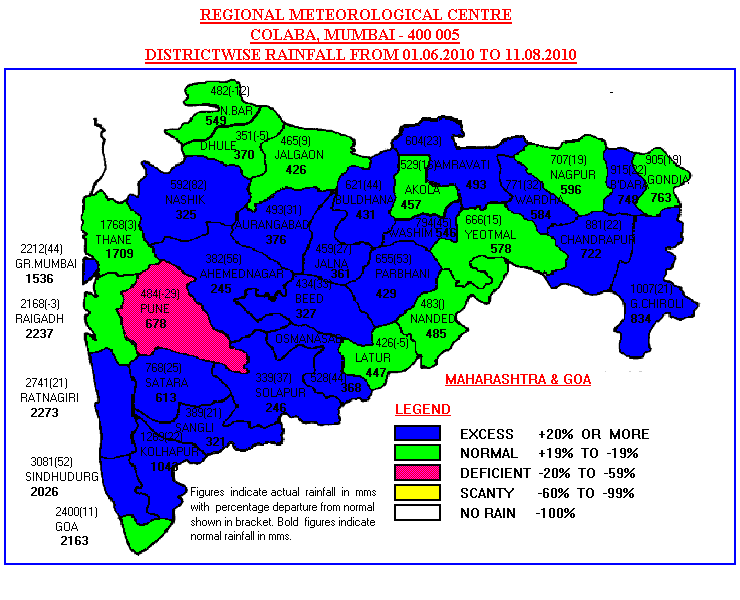
the rain data shows that majority of the districts have received much in excess of the normal rain.

last night we reaped the benefit and continue to reap the largesse from this cloud cover.


i used to track the monsoon in mahrashtra religiously, and here is the latest (Aug 2010) district rainfall map.
mah should have nothing to complain. of course, this is assuming that enough water has been stored up in the ponds, lakes, dams, reservoirs, etc.

2010 overall monsoon over india is a considerable improvement from a dismal 2009.
other than a very strong feel-good factor, i think that the above data doesnt matter!!
what say?

Tuesday, August 17, 2010

gopalkrishna gandhi - respect

gk gandhi is special. he has a pedigree which is unquestionably of the highest class.
grandson of mk gandhi and c rajagopalachari.

but he is in a class of his own.
from the time he was the governor of west bengal (2004-2009), he has been in the limelight with his doings.

came across his latest speech to lawyers of the madras high court- titled 'respect'. superb

his earlier 2010 convocation address to the IIT madras graudates also shows his class. (if anyone can link the entire address, do send).

Sunday, August 15, 2010

varagu - planting

those who recall my post on hardy and nutritious millets, may also recall that we planned to convert to a millet centric diet and hence plant a lot of millets (csm - what are the chances?!).

ploughing away, some of you will recall us keeping to this promise based on our planting ragi.
a few may have raised eyebrows when they read that we had planted rice.
(those who have successfully remembered all the above posts should seriously read a few other blogs).

but rice planting was after we planted varagu (kodo millet in english, kodon in hindi, kodra in marathi, harka in kannada and arikelu in telegu).
we had our first taste of varagu (available in reStore in chennai) when my bhabhi made pongal (the sweet as well as the breakfast variety) using varagu instead of rice.
very tasty and filling.
for interested cooks, do a find 'rice and replace with 'varagu' in sambar rice, khichidi or above two items. guaranteed better results - taste and health.
more millet recipes here.

i had part ploughed a piece of land around 2 months ago after the pre-monsoon showers.
to add fertility, we sprinkled some dried cow dung and we had planted some sunn hemp.
a month later, we ploughed the field again and the sunn hemp into the soil.
now it was ready for planting in the aadi maasam (mid july to mid aug).

the day we planted rice, we planted varagu.


the seeds were broadcast.


the common method after broadcasting is to re-plough the field with bullocks to cover the seeds.
since we could not arrange for 2x4 legged animals, we used 2x2 legged animals.
using crudely devised methods and implements, we ran over the field hoping to replicate the effect of a plough.


it looked well covered at the end of it.


if the heavy rains which filled up our rice field has not washed away the varagu seeds from this field, in 5-6 months, we should have a good harvest.
it takes around 1.5-2 weeks to sprout. so we are waiting with bated breath.
watch this space.

Thursday, August 12, 2010

appudu is here!

after copping a lot of flak for poisoning the toe-nibbling rodents, we have taken the most obvious and simple solution...

appudu is here.

4 months old, jet black, watery eye, he has already set upon himself to keep the pavilion rodent-free.
he was on our acquisition radar for some time, and it was rather sudden that the deal was finalised.
his claws will, over time, damage the ropes that hold up the pavilion. but we shall conjure up a solution.

Tuesday, August 10, 2010

"we are all valedictorians"

do read this wonderful speech by top of the class student Erica Goldson during the graduation ceremony at Coxsackie-Athens High School on June 25, 2010.

a telling commentary on the current public education system in the USA. it is quite the same in India whichever education service provider you choose (government/private).
Erica lays it out quite dramatically...
But now, I have successfully shown that I was the best slave. I did what I was told to the extreme. While others sat in class and doodled to later become great artists, I sat in class to take notes and become a great test-taker. While others would come to class without their homework done because they were reading about an interest of theirs, I never missed an assignment. While others were creating music and writing lyrics, I decided to do extra credit, even though I never needed it. So, I wonder, why did I even want this position? Sure, I earned it, but what will come of it? When I leave educational institutionalism, will I be successful or forever lost? I have no clue about what I want to do with my life; I have no interests because I saw every subject of study as work, and I excelled at every subject just for the purpose of excelling, not learning. And quite frankly, now I'm scared.

The majority of students are put through the same brainwashing techniques in order to create a complacent labor force working in the interests of large corporations and secretive government, and worst of all, they are completely unaware of it.

Monday, August 09, 2010

planting in the rain

it rained on saturday night (august 7, 2010).

after a period of nearly 2 weeks.
our sowing plans were getting out of sync. the aadi maasam (mid july to mid august) is an auspicious sowing time in tamilnadu. the SW monsoon rains would have blessed the soil with enough moisture. and there would be a few more sporadic showers in the later months during the crop growth phase. sufficient to raise a crop before the big rains during the NE monsoon.
but the 2 week dry spell left us wondering if this crop could be considered at all.

and saturday happened.
and we jumped up with glee and jazzed up for planting.
the selected crop was rice. the breed is called nawabi kolam. the source was the legendary bhaskarbhai save. it is a 175 day crop and grows to around 6 feet in height.
the selected spot is a small pond - around 1500 sq feet area. very small indeed. but we were just going to trial rice growing.
this pond gets filled up with the run off from the nearby areas during heavy rains and we expected that the top soil settled in its bottom would be reasonably fertile. in tamil, pond/tank silt is called vandal man. and is very rich. and farmers lap it up.
we had ploughed the plot 3 weeks ago in anticipation of the sowing.
here it is.

the grass bundles are for mulching once we sow.

the idea is to grow rice without the conventional methods - nursery preparation, transplanting, flooding for weed control, etc.
we were going to plant the seeds directly into the soil and water as and when required without flooding. we were hoping that in case it rains and the pond fills up a bit, it would not affect the crop.
so we hunkered up and planted seeds in gaps of 1.5 feet.

it took us (3 people) around 2 hours of work. one would make a depression with a stick and another would drop in a couple of seeds and close the depression. (yes, i did some of that and not just clicking pics).

and guess what.
it poured sunday night. the highest rainfall ever since we landed here. and the early morning sight that greeted us was...


wait...all is not lost. we have found out that the seeds we planted will survive this flooding (any other planting method would have been wiped out).
if the pond dries out reasonably within 2-3 days, the seeds will sprout and the experiment will continue.
what amazing rain and what amazing timing!

sharing habitats

we had a serious problem with the rats and adopted a shock-n-awe approach.

but this new fellow is in an altogether different league.


scorpions, like rats, by virtue of sharing the same habitat as humans, run into serious conflict.
snakes on the other hand prefer to live in their own places.
others like lizards, frogs, ants, etc share our habitat, but are harmless and can be easily ignored.

back to this black lissome stinger. we sighted her at around 11 pm in the night of heavy rain. we immediately increased our potential energy and from that vantage, we observed her perambulate casually.
over 2 mins of frenzied parlays, it was decided to get 'rid' of her. and i chose a long plywood and did a steve waugh slog sweep over mid-wicket. i could not bring myself to stomp on her...

we found out that she is not an impulsive stinger and her first mode of attach is through her pincers (painful as it is) and has a 'no-first-use' policy with her stinger.
so we tread with a little less fear.