Eating is an agricultural act - Wendell Berry
Showing posts with label food. Show all posts

Saturday, May 28, 2016

paddy production - an indicator

in the previous 2 posts - ruin after rain - part 1 and part 2 i had indicated a surge in paddy production.
here is some evidence to back this.
the state govt (parallel to the center (via the food corp of india)) procures paddy for the public distribution via ration shops (PDS), aanganwadis (ICDS), mid-day meal scheme in government schools and the amma canteens.

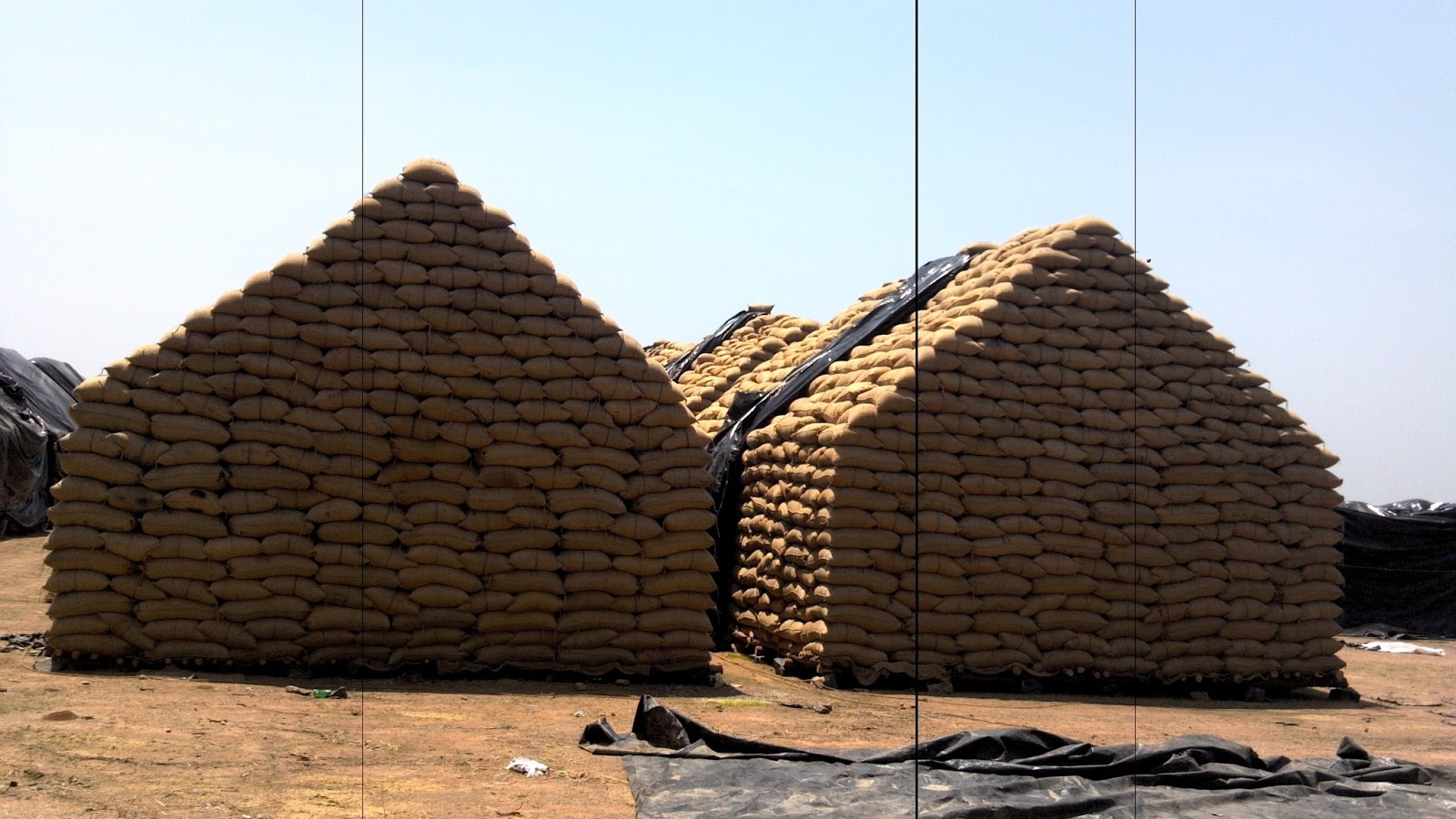
the surge in production has meant a surge in procurement and thus what you see below.

in this location, the supervisor indicated a total inventory of around 8000 tons of paddy.
from the time of taking these photos additional rows had been added. there is certainly one more such location in the vicinity and may be more in the overall district.
this is apparently a common sight in thanjavur - the main rice growing area of tamilnadu. and the entire crew is from there.
the stacking is highly artistic and the rain protection is superb. each sack is 40 kgs and each stack has 2992 sacks -> each stack has around 120 tons of  paddy. phew...


to answer a common query - this production surge is not likely to see any impact in the price of rice in retail. these economics are beyond us for now!

Sunday, January 18, 2015

2013-2014 production at TF

2013- 14 agri season - produce data

1. Paddy - 3000 kgs -> 1800 kgs of Rice.
Varieties: Kaivirai Samba, Mappilai Samba, Sura Kuruvai (sample fields - first experimental season) Vaikunta, Thuyamalli and  White Ponni (second season - own seeds).
Average yield - 950-1000 kgs of paddy per acre. Neighbours get around 1600 kgs paddy per acre. We expect that with more experience and better soil recovery, we could bridge the gap.
We have tried the SRI system as well as the conventional system. we are likely to use the latter more often than the former as we are unable to see much benefits.

2. Groundnut - 600 kgs of nuts. Majority converted to oil. Here our yields we comparable to neighbours.

3. Sesame - 50 kgs

4. Blackgram - 120 kgs

5. Greengram - 30 kgs

6. Ragi - 120 kgs

items 1 and 2 have thus far been the main crops for us - a reflection of the fact that it is the main crops in the neighbourhood.

we have extensively used the local workforce. we use tractors/machinery whenever other manual options are not available/feasible.

we have turned in a moderate profit overall.

along with the house building and all that, last season was quite something.

Thursday, May 26, 2011

pesticide in food - dire warning contd...

in response to the cabbage warning, my friend surio, has come up with this comment which he said (and i agree) deserve main page inclusion.

Quote
The Internet is our friend. Usually Bioingestion and Bioaccumulation damage is a build up that takes years but manifests quite suddently. Do you remember growing up in 80s India, and reading about mercury / poisoning / through fish consumption in Japan?

This will be somewhat similar. The brave should click here and here to get educated (or more scared, whatever the case may be).

My own personal take is that pesticide poisoning disaster is already manifesting itself in the other species and it is a matter of time before we are stuffed and cooked! Take a look at here and also at something called Colony collapse disorder among bees. Of course, there are highly evolved bird species such as Bee-Eater (Duh!) that feed on these bees and die-off en masse. It's OK, seems to be the stupid refrain, so long as it is not us, but the birds and the bees, it's OK. Even bats are being affected, but no one knows why it is happening yet.

Honestly, I don't know what an alternative to pesticide farming might be. This becomes even more paramount because if we stop pesticide use, there will be major crop failures for at least 3-4 seasons as crops will take time to build their resilience to pests. And while this happens, many of the 6 billion infantilised wastrels of a bipeds will surely have to die. Horrors..
Unquote

Saturday, May 21, 2011

cabbage - dire warning

in an 'i-told-you-so' fashion, my avoid-cabbage warning has been expertly explained here by s kannaiyan.

stop eating cabbage - it is nothing but pesticide.

ash gourd misery

a diverse story.

white pumpkin (real name - ash gourd) is one of the best and easy crops that grow in the summer.
full of water, it is a summertime treat.

we planted 4 varieties of seeds 3 different locations since mid january. we picked the right season and in fact spread our risk by planting with such diversity in variety and soil type.
but NOT a single bud to show for the effort....
no idea yet on why we were blessed this way.

on the other hand, our neighbouring farmer grew ash gourds over more than 5 acres and had a bumper crop over over 5 tons per acre.
while he managed to sell one lot, over the last 2 weeks, ash gourds prices have tanked to Re 1/kg.
he will not be able to sell over 15 tons of gourds.

they are lying in his field, unpicked and in a vain expectation of a recovery of the prices.
even if they perk up a bit, his fruits will be too mature to be sold.
sadness, indeed to see so much food going unused.


Monday, March 28, 2011

balanced scorecard


our expert artist, siddarth, has calligraphed this scorecard with pR's production data on a 'till-date' basis.
all values are in kgs.
a more elaborate, detailed version of the data is here.

Thursday, March 24, 2011

milling grains - standing up

we had originally envisaged a grain processing center with a variety of traditional indian chakkis.
the regular aatta chakki had become too smooth and we could not find a worksman to do the roughening.

in DV's travails around the web, he tracked down this stand up model - wonder mill - a hand operated grain mill.
we have a stand up oil press - piteba, which we have fairly mastered.
and this would be a good companion to the oil mill.

and after using it over the last week, we give it the full thumbs up.


at USD200 it is steep, but hope that a good indian model develops from this.

Monday, November 01, 2010

jean dreze interview

in what is a telling assessment of india's current social imbalance, jean dreze rakes our conscience with this - "the middle-class has lost track of how poor our country is".
this is an interview to tehelka commenting on the Food Security Act.

he says:
I think that the middle class has completely lost track of how poor this country is. We live in a make-believe world that exists only on television and small islands of privilege. That was the message of late Arjun Sengupta’s striking figure, that 77 percent of Indians live on less than Rs. 20 a day. The figure was not exactly right, but even if it was, say, 5 percent off the mark, the basic message remains. Are we saying that anyone who has more than Rs. 20 a day should be excluded from the PDS?
The Planning Commission is proudly talking of “infrastructural investment” to the tune of $1 trillion in the 12th Plan, about half of that would be public money. $1 trillion! That’s astronomical: nearly 10 percent of GDP, year after year. But for food security, 1 percent of GDP is considered extravagant — that’s not “investment”.
jean dreze is a hero on Farm, Yeah.
some dreze interviews and profiles can be accessed here and here.

Tuesday, October 19, 2010

ragi - processing and onwards

as promised on ragi-update, we are a month down from that post and bring to you our ragi post-harvest processing post.

we harvested the ragi in 3 installments due to differential maturing.
this is typically not the norm and is less efficient, but the field was a non-uniform one in terms of fertility, mulch cover and density of cow-pea planted as inter-crop.

ragi processing is quite simple and a fun exercise.

step 1 - maturing the ears
the harvested ears of ragi is piled up as a heap onto a cloth, tied up and allowed to steam inside for 3-4 days. this process matures the batch and all the ears become a beautiful uniform brown.
care is to be taken to ensure that the ears are dry when harvesting, no water ingress in this process and the harvest must be done only in dry weather conditions.

here is the pile


close-up of heap


no this is not our laundry


and they all are brown


after this maturing, the ragi ears are thoroughly dried. depending on the time of the year, this could last 1-4 days.

now the fun part.
those who have driven through rural india would have certainly noticed straw-like grasses spread out on the road and vehicles trampling them.
this is the classic method of loosening the grains.

in our case, we simulated that process by whacking with a log aka threshing.


after adequate bashing up, the pile looks like this. most of the grains would have settled down towards the bottom of the pile and the chaff at the top.


then we winnow. we use the wind to separate the heavier grain from the lighter chaff as we drop it from a height.


and when done, the grain remains on the tarpaulin and the chaff gets blown around the tarp.depending on the breeze, this process completed over 90% of the separation.


and whatever chaff remains is eliminated via the manual winnow.


and here we have the grain and the chaff.


our total harvest was around 12 kgs. considering that this was the second cropping attempt in this field, and the limited amount of external fertility we were able to add, and for a bunch of rookie farmers, this crop is an unqualified success :-)


our field was around 1/20 of an acre (approx 2500 sq feet).
the yield from an acre varies from 1000-1500 kgs.
so our field should have yielded 50-75 kgs of ragi and hence we are at 20% productivity levels.

we have a list of improvements for the next time.
1. soil fertility. add fertility prior to crop growing via cover crops, extra mulching, green manure and cowdung manure addition. over some years, the soil will reach and maintain its own optimal level of fertility as we move to fukuoka's natural farming approach.
2. transplanting density. we planted the saplings at 9 inch gaps. this will be halved.
3. intercrop. definitely not using cow pea as intercrop. explore other nitrogen fixing small bush type crops.

we are now enjoying our ragi koozhu breakfasts even more.

Monday, October 18, 2010

the indestructible McD meal

burger and fries must be the most popular meal in the world.
fast food system at its very effective best has mastered this meal.
and people are lapping it up like there is no tomorrow.

but wait, there is something you should see.
artist sally davies' science project with the McD's happy meal.

photographed over 6 months, the happy meal lives up to its name - 'happy'.

for parents who are struggling to wean their kids (or themselves) away from fast food addictions, this is a must read/see.

this is not a fool-proof indictment of fast food, but is a fun one.

these are the ones that should carry the tag-line - "please try this at home"

Wednesday, September 29, 2010

preserving vegetables

those who think work in pR is all about farming, trees and similar work, should certainly continue reading :-)

in days prior to hybrid seeds, fruits and vegetables used to be seasonal.
other than a few obvious fruits like mangoes, jackfruit, most knowledge of seasonaility has been eradicated from the memories of the populace.

but those like us who use mostly native seeds, seasonality is a real and an important factor in growing and eating.

till our parents' generation, one important skill that the women of the house had to master was the preservation of vegetables.
this is locally referred to as vathal making, i.e., sun-dried vegetables.

here is our experience with pavakkai/karela/bitter gourd.
as you would have guessed, we learnt this process from karpagam's mother.

fresh from the nearby farm - less than 24 hours since plucking from the field.

it is halved and then hollowed out (seeds removed).

sliced into thin discs and soaked in curd + manjal podi/haldi/turmeric + salt.


this soaking is done overnight and next morning, it is squeezed dry and laid out to dry in the sun.


it shrivels up in the heat for around 6-7 hours.


after the sun goes down, it is again soaked in the same curd mixture and kept overnight.
and laid out to dry the next morning.
this drying/soaking process is repeated for another two days/nights (with the same curd mixture) - this means a total of three days of drying.
you will notice how the discs swell up after the overnight soaking and shrivels up at the end of drying.

at the end, it will look like this.


this will store very simply for over a year.
they can be used after giving them a light sautee in all sambars/gravies or just deep fry and have it like crisps and have it with curd rice.

we did another vathal with kothavarai/cluster beans.
this is simpler.
boil the beans, lightly coat with the same curd mixture and dry.
if lucky, one drying day could suffice, else 2 days should be enough.
as a rule, the more the drying the surer you are about the shelf life.


for the hawkeyed, the final vathal shots are from batch 1 and the work-in-progress shots are from batch 2.

Sunday, August 29, 2010

how to end famine forever?

"by abolishing the word famine from the laws of the land."
sainath is caustic and scathing as ever.

this must rank very high in "top 10 absurdities"...
In 1963, the government of Maharashtra ended famine forever in the State. It did this without adding a morsel to anyone's diet. It did so simply by passing an Act in the Legislature that deleted the word ‘famine' from all laws of the State. No kidding. This was called ‘The Maharashtra Deletion Of The Term “Famine” Act, 1963” (And was dug up after decades by an independent researcher from Bangalore.)
what to do with the excess grain rotting in the warehouses?
Meanwhile, say the ‘experts,' the millions of tonnes of grain rotting in open yards present a “golden opportunity” for India to export this in bulk “and seize on the high prevailing global prices of grain.” That is also what the government hopes to do. Its affidavit in response to a slap from the Supreme Court speaks of liquidating the excess stocks by open market sale (read exports).
and what are the solutions to end food production shortfalls?
... we look around for ways to make up our production shortfall. Indian companies are buying land in parts of Africa to grow foodgrain. This finds approval with the Working Group on Agricultural Production set up by the Prime Minister and chaired by Haryana Chief Minister B.S. Hooda. Its report says “We should seriously consider these options for at least 2 million tonnes of pulses and 5 million tonnes of edible oil for 15-20 years.”
this solution is quite imperialistic and needless to say, idiotic.

sainath finishes with his trademark cynicism.
Will the courts say anything about the notion of shipping grain abroad when millions go hungry at home? Will the government say something other than ‘no' to the needs of the hungry? Will the NAC rethink its stand on a universal PDS? Will Parliament accept fraudulent definitions of food security? Will anyone speak for the Directive Principles of State Policy and how policy must work towards strengthening them? It would, of course, be silly to expect a government of this sensitivity to care a fig for the Directive Principles. But perhaps we can hope that the Supreme Court does?

Tuesday, July 27, 2010

rolling stones gather nothing but grind the grain

here is a look at our upcoming food processing center.

as we grow more grains and spices, we need to process them (de-husking, powdering, etc).
and to be reliant on our muscle power is the way to go.

so here is the line up. tamil name in bracket.
from left - idli batter grinder (aatu kal aka oral), grain grinder (enthiram), another design of idli batter grinder (aatu kal), wet masala grinder (ammi) and dry spices grinder (enthiram).


and we did the experiment with grinding wheat on the enthiram yesterday and here is the simple comparison between shop bought atta (left) and home ground atta (right) - ultra superfine shop atta vs micro fibrous home ground atta.


as a gentle aside on the benefits of home grinding, i quote from a research in rajasthan.
2 villages - one had an atta mill and the other did not, so they used the manual chakki.
comparing the delivery of babies, it was found that all the women using the manual chakki had a normal delivery and the women from the atta mill village had a majority of C-sections.
go figure.

Saturday, July 24, 2010

pumpkin peanut poriyal

we grow a fantastic variety of pumpkin (parangikkai in tamil and lal kaddu in hindi).
it grows small (baseball size) and transitions from flower to fruit like this.


we have quite the miracle creeper which was planted around november 2009, harvested in feb-march 2010, let it be till june 2010 when it re-energised itself and now, we are enjoying a glorious second innings.

classically used as a vegetable in sambars and gravies, we have also used in a simple dry curry (poriyal) with coconut garnishing.

annamalai, a veteran from the neighbouring village, is our full time consultant for agriculture, etc and is also the resident fireman (chief manager of the kitchen fire).
and he suggested the peanut twist. and we made it twice and it has become one of our several signature dishes.

Ingredients (for 3 people)
1. pumpkin (peeled and cubed)- 5oo gms
2. peanuts (roasted and coarsely crushed) - 3 handfuls
3. oil
4. red chillies - 3/4 nos
5. mustard seeds (rai/kadugu) - 2 tsps
6. bengal gram (channa dal/kadalai paruppu) - 2 tbsps
7. broken green gram (urad dal/ulutham prauppu) - 2 tbsps
8. salt

Method
heat oil in kadai. add mustard seeds, red chillies, both dals and as the dals start darkening, add the pumpkin cubes.
depending on the tenderness, we have cooked the whole pumpkin once and once we removed the central portion with the seeds.
keep on a low flame and let the pumpkin cook in its own water (i.e., do not add water). keep the kadai closed, but stir the poriyal from time to time.
in 5 mins or so, add the required amount of salt, stir a bit and close and cook on low flame for 5 more mins.
now sprinkle the crushed peanut powder and stir. and here it is.


garnish with coriander.
just lovely.

Monday, July 19, 2010

a question of health

a set of Qs for those who cook...
1. will you use any of dipotassium phosphate, sodium polyphosphate, glyceryl monostearate, pantothenic acid or tricalcium phosphate in your recipe?
2. do you even know what these chemicals are? what they do?
3. will you ever be able to understand them without a Masters in Chemistry degree?

these listed items are some of the ingredients in chocolate horlicks. the pdf version of this is here. do check the label the next time you are in the supermarket or look at the bottle in your shelf.
this is horlicks, which for generations, has been consumed as a 'health drink'.

the example of horlicks is just for illustration. such questions can be thrown up for any processed food item that you pick up casually at the supermarket.

come back responses will include:
1. these items are approved by government watchdogs across the world and hence are 'acceptable'.
2. i have been drinking this for ages and nothing has happened to me.
3. this is from a very reputed MNC, which personifies quality and health.
i concede these arguments. but those who go back over 20 years ago will recall that horlicks used to be the sole approved drink for those recovering from a serious illness. it has moved from the patient bed side to the kitchen cabinet.
smart marketing and convenience has helped make this move.
horlicks has replaced the home-made kanji. which has none of the listed chemicals as ingredients!! do they?

this and many more thought provoking insights into the modern food system is michael pollan's "the omnivore's dilemma".
Link
this is a must read.
he tracks back food-on-the-plate to its original source and the journey gives us an inside look at the dirty ugly world of modern day food processing. totally an america-centric book, but it is certainly totally applicable to the modern indian upmarket city-dweller.

i have been a keen follower of pollan for some time, but just finished his opus. he rises a notch higher.

Saturday, July 17, 2010

ODing on karamani

you have read the ragi-planting story.
you also may have seen the photo of the same field 68 days after planting. in case you missed, here it is.


we were faced with a crossroads scenario.
what to do with the karamani (cow pea)? it was clearly suppressing the ragi.
which was the main crop and which was supporting?
and so and such-like.

the matter was simply answered by annamalai, our local veteran farmer, who grumbled initially at this hare-brained combination planting.
with a huff, he declared that the karamani has had its time in the sun and its time to let it go and give a new lease of life to the ragi.
so onward we followed, and in 3 hours the field was cleared up.


we ended up with around 10 kgs of karamani. most of it was left to dry to seeds and use as the bean.

and now the ragi looks like it is good to go. a few showers in the last 2 weeks has helped its cause.
our estimate is that the crop will be ready to harvest in 120 days.
today we are at day 86.
next time, we do not plan to use this combination of karamani and ragi.

Wednesday, July 07, 2010

obsession with white...

...is likely to be the death of us.
clothes, teeth, skin, rice, flour, sugar.

giving it the veneer of purity, we are being taken for a grand ride by greedy, exploitative marketeers.

in my advisory that will go against conventional thinking, avoid food products that are white.
it is most certainly likely to have been 'manufactured' to use the white=pure equation.

Monday, June 14, 2010

pressing engagements

those who remember the post from a month ago - growing sesame - til - yellu - would recall that this was specifically for oil.
although i had said, "we shall be converting this small quantity into oil and that's another post coming up in 2 months from now.", it is time to reveal the oil press.

also, i would draw the reader's attention to the edible oil warning issued over 2 months ago. chances that sesame oil being mixed with cotton-seed oil is very high. and cotton-seed oil uses BT seeds....

so it was an imperative to press our own oil.

DV navigated through the haystacks of google searches to latch onto this beautiful needle - the piteba oil press.

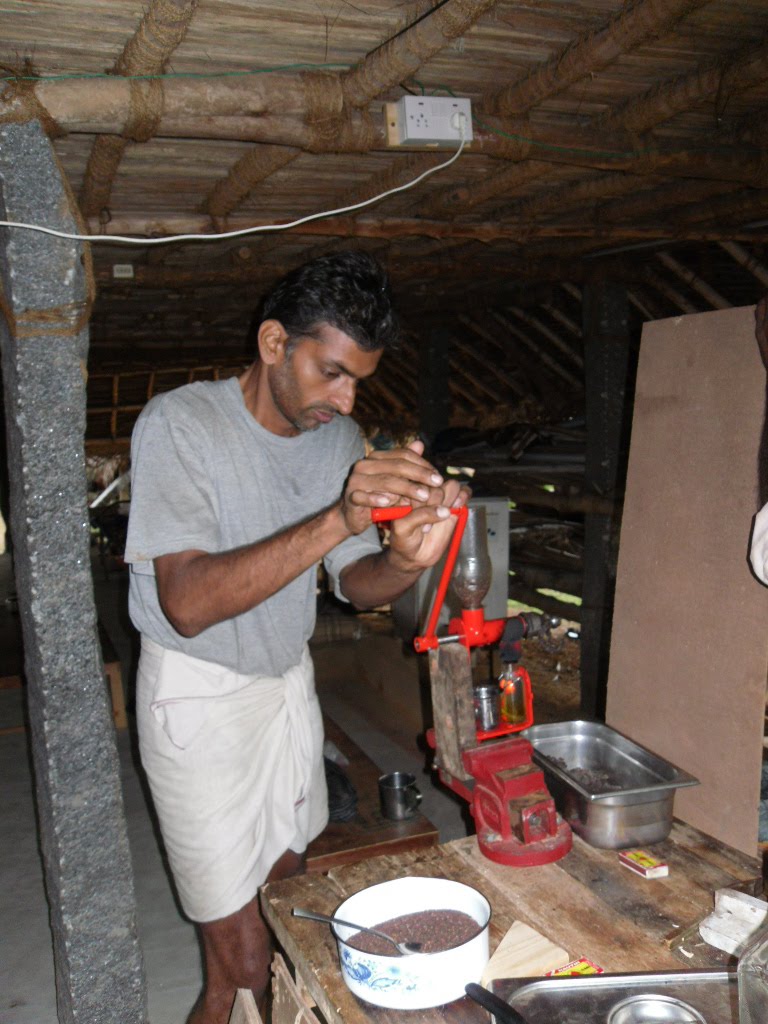
here is the full unit...the seeds are feed from the top (check the funnel). just left of the funnel is the crank which turns the screw encased in the horizontal red barrel. the metal cap on the right side of this barrel is the cake-extrusion point (you can see the snake-like extruded cake).
just below the barrel is the oil collection point (tumbler in the pic) and the glass bottle is the oil-based (kerosene or diesel) heating lamp.
we have only done a sample testing of the machine and after 3 iterations, successfully extracted the oil. while we will not refine the oil, we will refine the piteba oil press.


the crank has to be turned for the screw to turn and compress and squeeze the oil. in normal operations, the speed will be around 40 rpm and the oil-extraction rate is 2 litres an hour.


the oil is squeezed out of 2 slits on the lower side of the barrel and drips into the receptacle. below pic captures this quite beautifully.
the oil lamp is needed to heat the barrel. the temperature is expected to go upto 50-60 deg C. without this heating, the cake will just jam up at the extrusion point and it will take super human effort to turn the crank.


a close up, showing the cup that overfloweth.
notice the soot... we need to solve for that.


the oil will be mixed with some fine particles and appears dark when seen immediately after pressing.
but allow it to settle, it acquires the golden tinge of fine scotch.

it is now ready for consumption
since this is not 'refined' oil, it will not have much shelf life. remember that the 'refining' is merely to make the oil last longer in the stores, it is not purer!
freshly pressed oil will have to be consumed within 3 weeks of pressing.

highly recommended. stronger arms are a welcome side-effect.