Eating is an agricultural act - Wendell Berry
Showing posts with label farming. Show all posts

Saturday, May 28, 2016

paddy production - an indicator

in the previous 2 posts - ruin after rain - part 1 and part 2 i had indicated a surge in paddy production.
here is some evidence to back this.
the state govt (parallel to the center (via the food corp of india)) procures paddy for the public distribution via ration shops (PDS), aanganwadis (ICDS), mid-day meal scheme in government schools and the amma canteens.

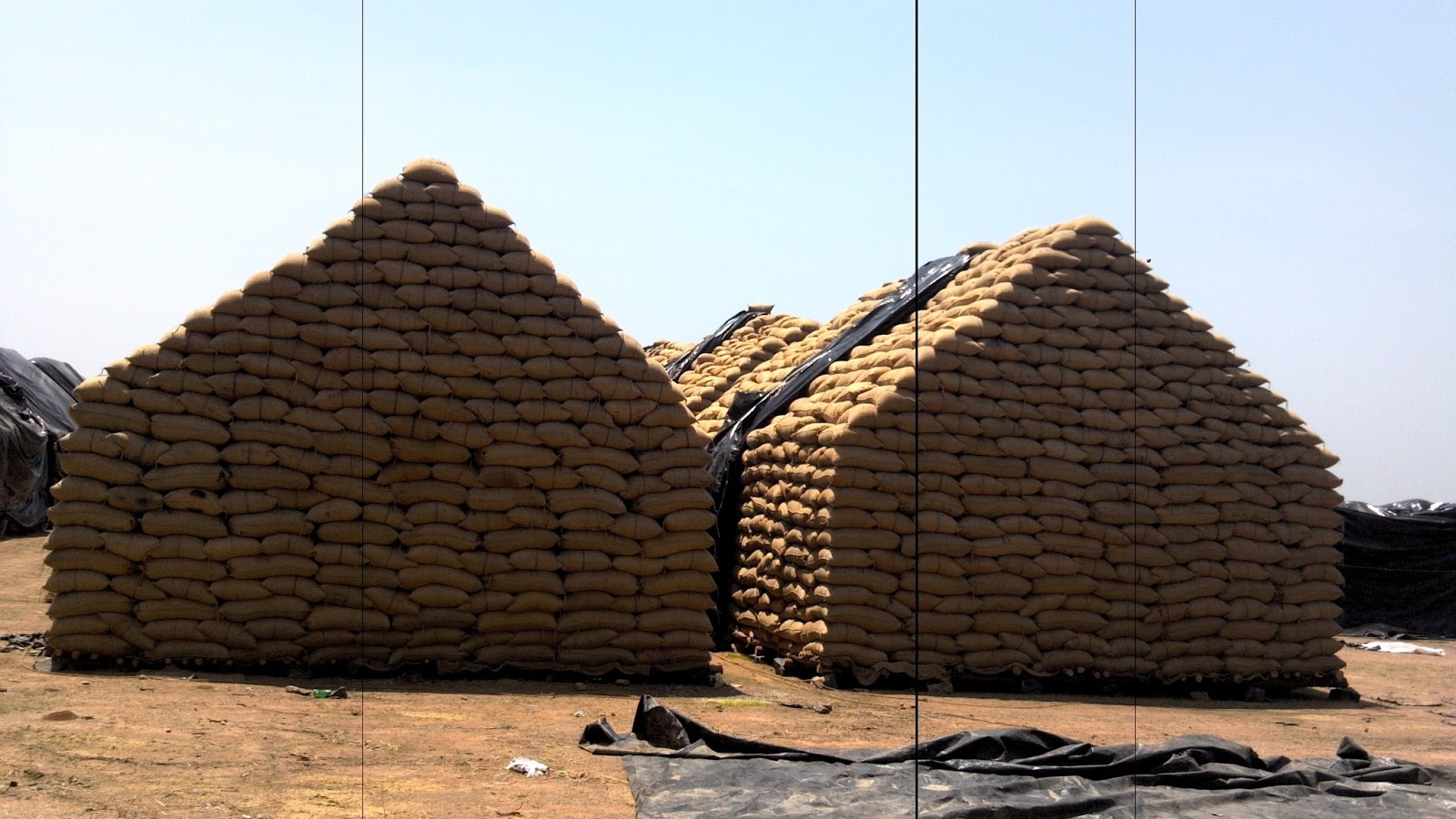
the surge in production has meant a surge in procurement and thus what you see below.

in this location, the supervisor indicated a total inventory of around 8000 tons of paddy.
from the time of taking these photos additional rows had been added. there is certainly one more such location in the vicinity and may be more in the overall district.
this is apparently a common sight in thanjavur - the main rice growing area of tamilnadu. and the entire crew is from there.
the stacking is highly artistic and the rain protection is superb. each sack is 40 kgs and each stack has 2992 sacks -> each stack has around 120 tons of  paddy. phew...


to answer a common query - this production surge is not likely to see any impact in the price of rice in retail. these economics are beyond us for now!

Wednesday, April 27, 2016

watermelon - watch ur melon

as briefly touched in previous post, watermelon (WM) has been a money spinner to farmers this year.
one of the obvious reasons has been the relentless heat right from Jan 2016 onwards, keeping the demand high through this year's 3 odd months.

it is also a fact that WM has not been this big a hit since 2011.  so it could just be an one-in-five year blip.

WM growing and economics - circa 2009 - from the TamilNadu Agriculture University (tnau) website, gives a complete breakdown of growing/chemicals used/yields/revenue-expenses-profit calculations.
careful reading of the above, clearly shows the regularity and intensity of use of chemicals over the 65-75 day growing period.
and the costs of these chemicals is approx Rs. 25000 out of a total of Rs 45000.
the farmer misses out on seed cost which is pretty high.
this year farmers in our area have made a profit of around Rs.50000-75000/acre. these kind of figures are impossible with regular-joe crops like grains/millets/oilseeds.

WM growing fields used to be a classic ridge-furrow system with flood-watering in the furrows once a week or so.
since the advent and growing popularity of drip irrigation and plastic sheet mulching, most WM growing is now by this system.
just image search for "watermelon sheet mulch" to get a sense of how WM field looks like.
and the drip irrigation ensures that all the growth-promoting chemicals are delivered right at the root zone of the plant.

this type of mulching lasts for 2 crops (i.e., 5 months) on an average and then is gathered and burnt and the process is repeated the next season.
hence there is a slow but steady influx of plastic particles into the soil.

that the final WM fruit is riddled with multiple chemicals is a undeniable fact. it is also true that the WM farmers barely eat their own output. even the local villagers are now wise to the fact of these WMs ill effects. it is not uncommon to see fields strewn with "off-spec" WM (misshapen, too small, etc.) and no takers for them, not even cattle.

we avoid WM unless we grow them.
readers are advised to be careful, very careful when it comes to eating this fruit.

regular readers may recall - watermelon bonanza from 2011.

Saturday, March 05, 2016

the ruin after the rain

the deluge in november 2015 and the floods of dec 2015 seem to be a distant memory now.

with this excess water, cropping area nearly tripled and the farming community looked for a prosperous and bountiful farming year.

but alas.....
it is only around 90 days since the rains stopped and already the well levels have dropped alarmingly. the lakes/tanks of the area will barely be able to cover one cropping season (till april end or so).

added to this misery, the pest levels are at astronomical levels. we have lost over 100s tomato/cauliflower/chilly plants, amongst losses of over 25% (estimated) in field crops of legumes/oil seeds.
in our 6 years, we have never seen pesticide sprays on groundnut crop (no. 1 cash crop of this area). already farmers (with cash) have resorted to 3 sprayings, and everyone at least 1. and this has barely had any effect.

paddy crop seems relatively less affected but due to oversupply offtake prices are likely to be depressed for paddy. 

as if this was not adequate misery, the farm lease rates and the daily agri labour rates had also gone up by 25-50%.

but agricultural labour never had it so good. employment was plentiful and labour rates were high. being election year mnrega allocation was in full swing and 'occupied' the time of most agri labour for better part of everyday. with mnrega taking away the 'need' for anyone to work for a living few were willing to work on agri fields. with lesser hands and hours for agri work, labour rates shot up and a lot of argi work (like field prep and de-weeding) were either not done or done very poorly with very stretched few hands.

sight from here is not pretty. pest and grass ridden fields with lone woman here and there fighting a losing battle against weeds and pests.

so in net result, it is scary to think what the farmer will be able to take home for all their efforts from this 'best growing season' of the year.

Monday, January 19, 2015

2014-15 season update

following a learning-filled  and moderately productive 2013-14 season, the planning for the current season started in july 2014.

as the july-aug SW monsoon was a failure, we undertook paddy planting in  staggered steps. we have planted almost the same varieties as the previous year.
the NE monsoon was a further disappointment. we recorded 35 cms between oct-dec 2014 as against a typical average of 55 cms. this happens to be the third successive year of deficit rainfall. the dry lakes in our area are an indicator of tougher times ahead.
the neighbouring farmers who would have planted their rice by mid oct, could only do so by late nov. and most of them are struggling.
the poor NE rains also meant that the paddy did not take off with the same vigour and insect afflictions were higher. it is said that the oxygen dissolved in the rain water invigorates the crop.

we have  planted around 100 nos mixed varieties of bananas. it is a very low cost crop and if the experiment goes well and we are able to sell without wastage, we could expand acreage in the coming years.

additionally we have groundnut, blackgram, greengram, cow-pea, sesame and mustard growing.

we wish readers a happy new year, pongal and more.

Sunday, January 18, 2015

2013-2014 production at TF

2013- 14 agri season - produce data

1. Paddy - 3000 kgs -> 1800 kgs of Rice.
Varieties: Kaivirai Samba, Mappilai Samba, Sura Kuruvai (sample fields - first experimental season) Vaikunta, Thuyamalli and  White Ponni (second season - own seeds).
Average yield - 950-1000 kgs of paddy per acre. Neighbours get around 1600 kgs paddy per acre. We expect that with more experience and better soil recovery, we could bridge the gap.
We have tried the SRI system as well as the conventional system. we are likely to use the latter more often than the former as we are unable to see much benefits.

2. Groundnut - 600 kgs of nuts. Majority converted to oil. Here our yields we comparable to neighbours.

3. Sesame - 50 kgs

4. Blackgram - 120 kgs

5. Greengram - 30 kgs

6. Ragi - 120 kgs

items 1 and 2 have thus far been the main crops for us - a reflection of the fact that it is the main crops in the neighbourhood.

we have extensively used the local workforce. we use tractors/machinery whenever other manual options are not available/feasible.

we have turned in a moderate profit overall.

along with the house building and all that, last season was quite something.

Monday, November 07, 2011

millets harvest - update

we had a classic manavari (rainfed) aadi pattam this year - adequate sun with adequate rain.
our sowing was timely and so the reaping was not bad. mahesh & sujatha and ananthu & sumathi had come over to help us with the harvesting. it was a lot of fun & banter.

harvest update

1. foxtail millet - thinai (2 varieties - yellow and red).
sowed in patches of 3 cents each. harvested 16.5 kgs in total.
days to maturity - 63 days

we harvested the thinai by cutting the stock from bottom, dried it and beat it to get the grain. processing will involve pounding (kai kutthal) the gains in a mortar with a pestle (voral and ollakai) and winnowing away the skin. apparently thinai has 7 layers of skin and so needs to be pounded 7 times. we got edible grain after pounding 4 times. we replace rice partly with thinai while making pongal and it is delicious.


2. pearl millet - kambu (bajra) - 2 varieties (hybrid and native)

a) native kambu: smaller grain and looks more like thinai than the classic bajra.
Sowed in 3.5 cents. Harvested 9.5 kgs.
days to maturity - 62days
native kambu is a great find. easy to grow, easy to harvest, easy to process and delicious to consume. seems to be hardy as well.
we cut the crowns from the top, dried them and beat them to get the grains. one pounding in the voral and winnowing gives us clear grains. we grind them and then use them to make porridge (kanji) and rotis. rotis made with 50% native kambu and 50% wheat were very tasty.

b) hybrid kambu:

largest grain size among all millets. we are not sure if this is hybrid or another variety of native kambu. however the shopkeeper who sold us the seeds called it hybrid and so we will as well.

Sowed in 4 cents. Harvested 4.5 kgs. we lost out to some attack where the grains started to turn black due to heavy rains prior harvest.
days to maturity - 77days

here too we cut the crowns (of what remained after the attack) from the top, dried and beat them. it took longer to process this 4.5kgs when compared to the 9.5kgs of native kambu. we have not consumed it yet, but have seen recipes for "khicidi" on the net.


3. little millet - samai
sowed in 2.8 cents and harvested 7.5kgs
days to maturity: 78 days

we cut the stock from the bottom, dried and beat to get the grains. we are yet to process and consume.

4. groundnut
sowed in about 4 cents and harvested 13 kgs.
days to maturity: 83 days.

in these parts groundnut is sowed mainly in karthikai - margazhi pattam (nov-dec) just after the withdrawal of north east monsoon. it is grown as an irrigated crop to get optimum productivity. however, aadi (july-aug) sowing used to be done as a rainfed crop (lower productivity) to get seeds for the main pattam. offlate, people have done away with the aadi sowing as they prefer to buy seeds . we got a just enough for our karthikai sowing.

it is supposed to take about 100 days during the irrigated season. our rainfed one came to maturity earlier and we had to take it out to stop the rates and squirrels from helping themselves generously to the pods.

ps: our camera packed up and so no pictures of the harvest.

Monday, June 06, 2011

well done indeed

start digging a well and unleash the ghosts...
so goes a tamil saying which summarises the intense effort and agony involved in digging a well - or getting a well dug.

thus many have started resorting to the use of borewells - which take no more than a day to drill and access the deep tranches of groundwater.

but, a well is unmatched as the preferred personalised water storage device for a farm. just the sheer volume of water it stores gives the farmer many options.

for over 3 years, DV has been steadfast in not unleashing the ghosts.
but as a necessary step towards increasing our agricultural area, a well would be critical and we were ready to take on the ghosts.

first step is place identification - very importantly, it has to be at a place where the underground springs are copious and generous.
we trust that our rain water harvesting initiatives should help these springs and hence our well.
we did this through a water diviner. it could have been a little sham act of sorts, but we just went with some faith and some logic.

then the diggers take over.
spec sheet
1. diameter - 21 feet for the first 15 feet depth.
2. diameter - 12 feet for the second 15 feet depth.
the intermediate 4.5 feet wide annular space (at around 15 feet) will be the base on which the retaining wall will be raised to prevent the top part (item 1) does not capsize through rain and erosion.

the retaining wall is another story.

so here we go with the digging.

as always, we start with the pooja. the yellow shirted gentleman is the lead digger.


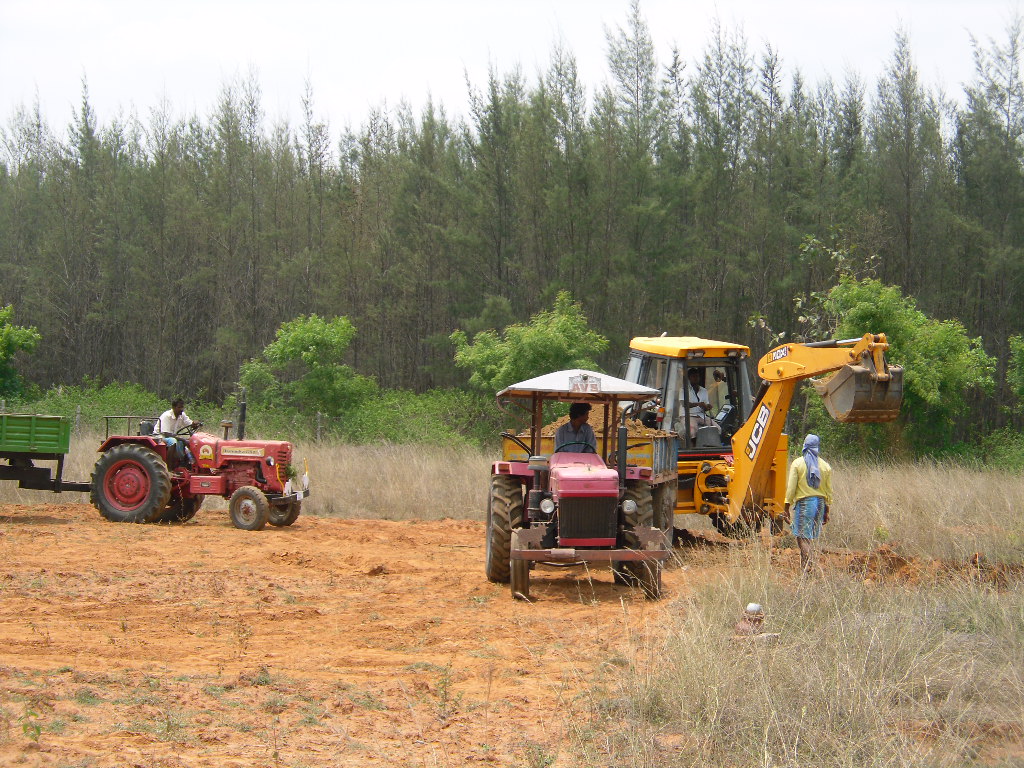
the use of the back-hoe (JCB) is now common practice. this monster gouged out around 11 feet deep of the top diameter cylinder.


the dirt is hauled with tractors. top soil to the fields, rest spread for road repair, other future building works.


the hole starts to develop.


in its developed state. around 7 hours of JCB work it took to get to this size.


now we move into manual zone. a crane is installed. 


the dirt is manually loaded onto buckets and craned to the top.


once we hit the rocky substrata, the explosives come out. this is another regular practice to speed up the process. notice the drilling going on, as well as the tubular explosive packs in his hand. they are packed into the drilled holes.


see the spots where the explosives have been packed into the earth.


after the boom , this is the rubble which then gets hauled out.
they used explosives 7 times through this digging.


and at last, the first sight of water. this was noticed at a depth of around 24 feet.
well digging is done in summer for the simple reason that the water levels/springs are at their lowest flow and if you manage to hit a decent water level in summer, you should be well taken care of for the other seasons.


as the last bits of debris is being cleared, the final look.


the final pile of rubble.


after the initial JCB work, it took around 65 person days to complete the digging.
at a total cost of 75K, it is a reasonably modest expenditure for a well.
the digging team - led by the very hard working Mr T Govindan - was very professional and we would strongly recommend them.

Friday, March 25, 2011

watermelon bonanza

2 of our neighbouring farmers planted watermelon in january 2011.

WM is a good cash crop, but is a high risk game. in our 14 months, 2 earlier attempts at WM have been resounding flops.

WM involves a high level of pest management - both of the insect variety, the animal variety and the human variety.

while the insect variety is apparent, it will surprise readers that foxes have a liking to play (not eat) with the fruits. also monkeys are known to render a farmer to despondency.
of course, the human insects are the most insidious and malicious.

so insecticide use is heavy and accepted and common.
while one neighbour resorted to electric wire fencing, the other sat through the night banging on this tin can making enough noises to keep the foxes at bay and give us some sleepless nights :-)
and this he did for over 3 weeks from the time the fruits matured.

this is Rs 200 worth from his harvest (the tin-can-banger).
he spent around Rs 35K over 2 acres and looks to have grown around 17 tons of WM (phew) at Rs 4.5K per ton. a profit of approx Rs 22K per acre, which is handsome (high risk, high return).

interestingly, the harvest was done on day 1, the truck loaded on day 1 evening, reaches bangalore day 2 early morning and is sold by end of day 2.

exchanging plesantries with him over the purchase, he swore never to raise this crop again...cannnot manage this level of night-outs!!
we heartily applaud his decision...

Sunday, January 23, 2011

ragi - take 2

the first ragi crop was an over-documented story.
and gratefully the output was commensurate to the documentation.

but more importantly, it was the first step on the move towards fukuoka's 'no-till' farming.

coming back to ragi.
it remains our most commonly eaten millet.
in the summer, 3 out of 4 breakfasts are ragi koozhu.

so the math was simple, one crop a year did not seem adequate. we would need at least 30-40 kgs of ragi per year for our own consumption.

and this was the season for any crop and we wanted to take a shot at a 3 month variety.
since we got the seeds from the guys who grow, consume and seed-save it regularly, we assume that this is not a hybrid seed variety.
the locals call it 'kulla kevaru' - short ragi.

since we had already used around a third of this mulched field for our vegetable scale up, we have attempted the transplant method on the balance of this field and have tried a simple broadcast approach on a nearby field.

the major differences from the previous planting were:
1. closer spacing - approx 6" between the saplings.
2. no inter-crop - last time we used cow pea - karamani.
3. and of course - the seed variety is a 90 day crop

the method was very similar to the previous time.

the nursery...around 25 days.


and the transplanting (much easier this time as the soil was softer and the team was more experienced.


and the final field...


as we always say, keep watching this space.

rice experiment 2 - update

the first rice experiment in the pond did not come through.
the second experiment is running and was on a different spin. to grow it in a rain-fed manner and without any flooding.

we had planted a 3 monther (variety called gundu) and a 4 monther (variety called thuyamalli).

have to say that they look reasonable.

the field with gundu...


though they are running a bit behind schedule, we realise that even this level of maturing with the very poor level of fertility is amazing. check the close ups of the grain heads.


the field with thuyamalli...a mite less promising than gundu.


maybe in a month, you should read about the harvest and stuff.

Wednesday, January 05, 2011

varagu - down and out

we planted in early august and saw it do decent upto a couple of months later.
but since december, we were quite in doubt over it.
one - there was a certain lack of height and colour in the stalk.
two - very few stalks had let out the grain crowns.

so, we have as of today,cleared the field entirely after bidding a quick good bye.

it left us with some questions to answer.

so, there was a lack of something which caused this debacle.
it was certainly not water (though one hypothesis could be excess water!!).
the seeds could have been poor quality, but this is a low factor as the early stages showed promise.
so, we are hypothesising that it was a lack of fertility in the soil.
this assumes greater chances as even the weed growth in the field was sporadic to low.

to continue the flow, we covered the field with manure and ploughed it and plan to try our regular and classic january crop - yellu/sesame/til.
and we will not be able to follow any of the 5 improvements planned from last year as we have changed the field :-)
so much for advance planning...

and dear readers - happy new year and all that.

Monday, January 03, 2011

scaling up grains

you may have seen our plans on scaling up vegetables.
it came about as a sidelight to our planning on expanding our grains production.
with a few experiments under our belts with ragi, rice, varagu, tenai...we were ready for more.

a 100 ft by 100 ft plot was cleared up (by hand) and ploughed once in october.
the initial idea was to cover this area up with green manure crops and let them provide cover and nutrition and we would plant grain for the 2011 adi pattam (july-aug).
but while ploughing, we realised that this plot seemed to have some fertility.
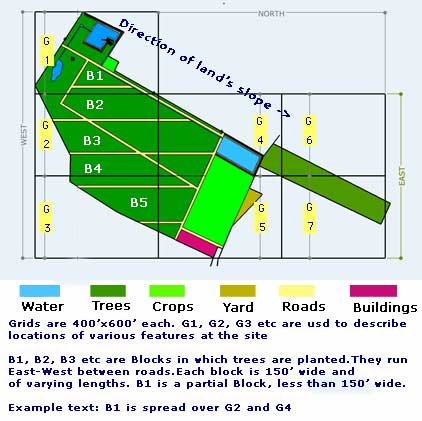
topographically, the area we selected was towards the eastern side of pR which was the downward end of the slope. so it could have been at the receiving end of the runoff from the western sides and hence the fertile look.
see this map for a visual depiction of the above paragraph. we are talking here about the parrot green part.


note - we have modified our tree planting to a north-south pattern between the swales as against the blocks mentioned in the map.

so realsing that we could use the inherent fertility for a early shot at scaling up, we went ahead with a combination plan.
1. half of this field was sown with pachai payir/green gram/moong. this was the correct season and with the current market rates, it was a no-brainer.
2. quarter of the field was sown with kambu/horsegram/bajra.
3. the final quarter was with karamani/cowpea/chowli beans.
items 2 and 3, could give us some output, or could just remain as ground cover.
4. to respect the original thought of green manuring this plot, we have planted tuvarai/pigeon pea/toor and velvet beans along the edges, cholam/sorghum/jowar along with the cowpea and sanapai/sunnhemp in 2 rows in the moong plot.

i forgot...this plot will not be irrigated.
we expect the soil to have enough moisture from all the rains to provide the crops with their requirements.
well, lets see :-)

Tuesday, October 26, 2010

compost piles - update

we made our compost piles in early june 2010.
now we in end oct 2010. over 4.5 months of composting.
during this time, we had good rains (at least 20 days of rain).

we did check the piles over the interim and could feel the warmth that accompanies decomposition.
also we were in no hurry to use the compost, and so we let it continue to mature.

last week, we got our shovels out and emptied out half of a pile onto our new rice field and our vegetable beds and the mango trees.

the pile was nearly 4 feet when created. over four months, it has sunk to less than 1 feet.
so a total compost volume generated of 30 cu feet per pile X 2 piles = 60 cu ft.
320 cu ft -> 60 cu ft

smells lovely, feels moist and crumbly.
looks like we added a little more soil than required during the layering.
you can almost see the soil (last pic).


if you compare the pics from the june to oct, you will not fail to notice the intense vegetative growth surrounding the piles.

Saturday, October 23, 2010

approaching fukuoka

we completed a reasonably successful and highly satisfying ragi harvest.

smelling a chance to use this opportunity to convert this patch into a natural farming process, we jumped this chance.
simply explained, the NF approach emphasises on 'no-tilling' and 'permanent cover' over and above the 'no-chemicals-no-organic-manure' philosophy.

the master, masanobu fukuoka, pioneered this approach and has beautifully explained this in his books. of course, there are a host of other farmers who have used this method for ages.

so here we are making the baby steps towards fukuoka.

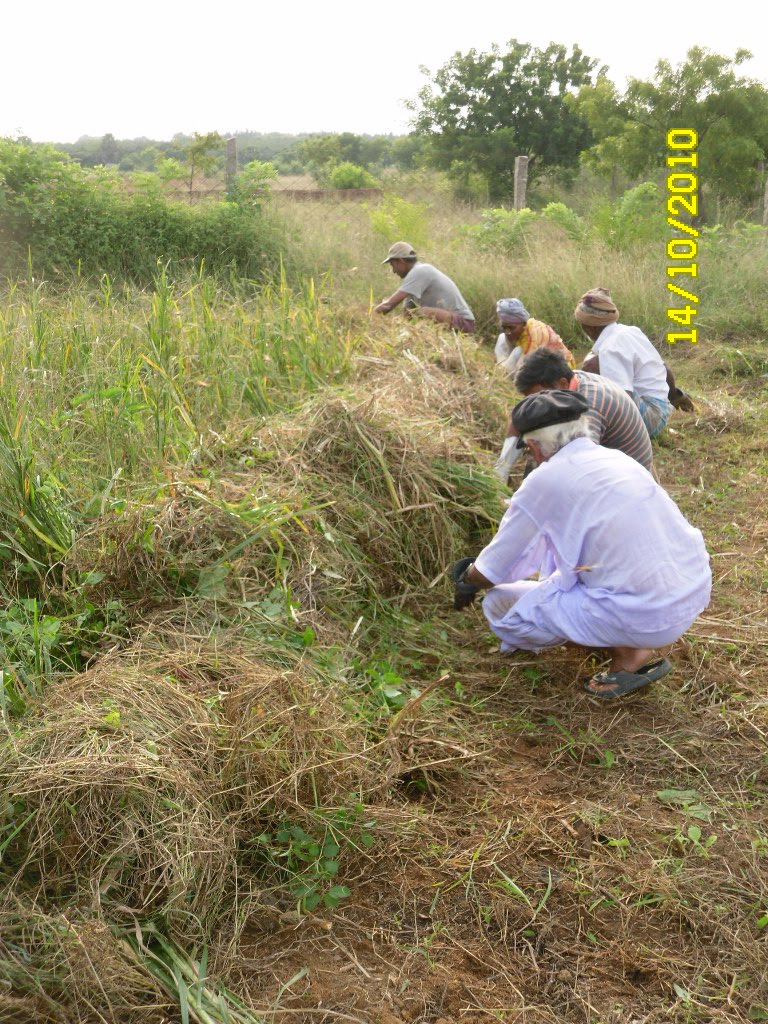
clearing the field (all the ragi stalks and weeds) were cut at ground level and laid down at the same spot.
just prior to this, we sowed a mix of seeds (cow pea, daincha and sunn hemp).
so as we stomp through the field for chopping, these seeds embed into the soil.


we used the csm-patented carpet roll technique :-)
the team squats in a line, directly faces the grass and each member cuts the grass in a continuous line and then rolls the cut grass away from themselves like a carpet.


the tough part is the roll back of the carpet.
and to our surprise, the carpet was not sufficient to fully cover the field.
we had to move out of the classic approach here, by chopping the bordering glyricidia trees (excellent green manure) and dropping it into the gaps.


here is the team enjoying the outing in the sun.


here is the final field as it looks.
look carefully at the background in above and below images to understand where the glyricida trees were .


and within 4 days, the sprouts of the green manure show up.


in a couple of months, when our next planting season arrives (early to mid december), these will again be chopped and dropped and we shall move onto the next crop.

Tuesday, October 19, 2010

ragi - processing and onwards

as promised on ragi-update, we are a month down from that post and bring to you our ragi post-harvest processing post.

we harvested the ragi in 3 installments due to differential maturing.
this is typically not the norm and is less efficient, but the field was a non-uniform one in terms of fertility, mulch cover and density of cow-pea planted as inter-crop.

ragi processing is quite simple and a fun exercise.

step 1 - maturing the ears
the harvested ears of ragi is piled up as a heap onto a cloth, tied up and allowed to steam inside for 3-4 days. this process matures the batch and all the ears become a beautiful uniform brown.
care is to be taken to ensure that the ears are dry when harvesting, no water ingress in this process and the harvest must be done only in dry weather conditions.

here is the pile


close-up of heap


no this is not our laundry


and they all are brown


after this maturing, the ragi ears are thoroughly dried. depending on the time of the year, this could last 1-4 days.

now the fun part.
those who have driven through rural india would have certainly noticed straw-like grasses spread out on the road and vehicles trampling them.
this is the classic method of loosening the grains.

in our case, we simulated that process by whacking with a log aka threshing.


after adequate bashing up, the pile looks like this. most of the grains would have settled down towards the bottom of the pile and the chaff at the top.


then we winnow. we use the wind to separate the heavier grain from the lighter chaff as we drop it from a height.


and when done, the grain remains on the tarpaulin and the chaff gets blown around the tarp.depending on the breeze, this process completed over 90% of the separation.


and whatever chaff remains is eliminated via the manual winnow.


and here we have the grain and the chaff.


our total harvest was around 12 kgs. considering that this was the second cropping attempt in this field, and the limited amount of external fertility we were able to add, and for a bunch of rookie farmers, this crop is an unqualified success :-)


our field was around 1/20 of an acre (approx 2500 sq feet).
the yield from an acre varies from 1000-1500 kgs.
so our field should have yielded 50-75 kgs of ragi and hence we are at 20% productivity levels.

we have a list of improvements for the next time.
1. soil fertility. add fertility prior to crop growing via cover crops, extra mulching, green manure and cowdung manure addition. over some years, the soil will reach and maintain its own optimal level of fertility as we move to fukuoka's natural farming approach.
2. transplanting density. we planted the saplings at 9 inch gaps. this will be halved.
3. intercrop. definitely not using cow pea as intercrop. explore other nitrogen fixing small bush type crops.

we are now enjoying our ragi koozhu breakfasts even more.