the extended rainy season and the shortened winter period put paid to our potato aspirations.
one bed was wiped out by the wilt and one bed was lost in transplanting (we planted originally in the wrong place).
total planted weight = 3 kgs
total output = 2.5 kgs
and we attempted mounding to promote additional tuber development, which also flopped.
we have realised that there are other tubers which grow in our climate and are planning to expand our tuber portfolio.
Showing posts with label home gardening. Show all posts
Showing posts with label home gardening. Show all posts
Sunday, March 06, 2011


Friday, January 28, 2011
colourful corn
deepika and bernard at pebble garden gave us some corn seeds.
they were from the western ghats of karnataka.
such beautiful colours and combinations...

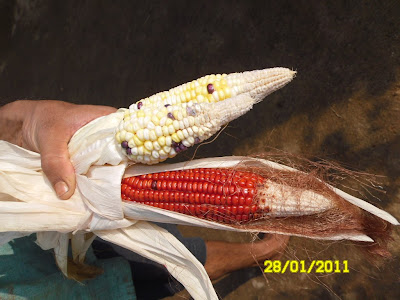
they were from the western ghats of karnataka.
such beautiful colours and combinations...


Thursday, December 16, 2010
papayas
after cracking the banana code, papayas are next.
we have been planting seeds and saplings since early this year with near total wipe out.
we kept hearing that it is best left to nature. just cast the seeds after eating them and thats that.
so we finally gave up the attempts and followed the above principle.
and that worked from the germination end, but we chose bad areas to drop the seeds and the saplings died out.
then 2 strokes of luck.
one sapling we had forgotten about, survived the early stages and came through very vigourously. it is growing right at the exit of the wash water from the bathroom and get copious water.
the second stroke was from the 2 piles of compost that we bought from the nearby village.
each pile was a veritable papaya jungle. obviously some cow had munched through a papaya and fertilised it thorough its digestive system and dropped it intact and ready to take off.
and boy did they.
so now we are close to cracking the code.
papayas have male plants and female plants. and hence there is only a 50% probability of a fruiting tree.
the girl plant


the boy plant


and our jackpot tree.

as raj mentions, it is one of the least demanding of trees.
now we have a combination garden area with bananas and papayas surrounded by the pit and trench beds.
we have been planting seeds and saplings since early this year with near total wipe out.
we kept hearing that it is best left to nature. just cast the seeds after eating them and thats that.
so we finally gave up the attempts and followed the above principle.
and that worked from the germination end, but we chose bad areas to drop the seeds and the saplings died out.
then 2 strokes of luck.
one sapling we had forgotten about, survived the early stages and came through very vigourously. it is growing right at the exit of the wash water from the bathroom and get copious water.
the second stroke was from the 2 piles of compost that we bought from the nearby village.
each pile was a veritable papaya jungle. obviously some cow had munched through a papaya and fertilised it thorough its digestive system and dropped it intact and ready to take off.
and boy did they.
so now we are close to cracking the code.
papayas have male plants and female plants. and hence there is only a 50% probability of a fruiting tree.
the girl plant


the boy plant


and our jackpot tree.

as raj mentions, it is one of the least demanding of trees.
now we have a combination garden area with bananas and papayas surrounded by the pit and trench beds.
Sunday, December 12, 2010
potato planting
a year ago, on some random push from me, DV planted a (SINGLE) potato and surprise surprise, it was a good output. we had harvested nearly 1 Kg from that single plant.
my mail was inspired by the potato tower experiment of Rob (of one straw-be the change)
we were certain that we would try one winter crop of potatoes, even though it has never been tried in the local area. except for the hill parts of Tamilnadu, no other place grows potatoes.
but the reason is purely commercial and not because it would not grow.
with the warmer winters in these areas, the chances of good tuber growth for a good yield and hence good money is low and hence no one attempts to grow them.
but here is our attempt.
aim is to plant around 5 kgs of potatoes as seeds and be happy with what we get :-)
step 1 - prepare a very loose soiled bed. we dug/loosened the soil upto 4 inches depth and then added around 2-3 inches of compost/loose soil.

step 2 - select potatoes with strong sprouts. these were potatoes from agra, which has a better sprouting tendency.


step 3 - cut them into halves (not smaller than thirds).

step 4 - place them on bed with approx 18 inches spacing.


step 5 - cover with compost and mulch

the trick (we learnt from Rob) is to hill the bed (cover with straw and compost) as the stem grows and allow for each node to further develop into tubers. so the final bed will be another 6-9 inches higher than it is now.
we shall see how this develops.
another 4 kgs to go....
my mail was inspired by the potato tower experiment of Rob (of one straw-be the change)
we were certain that we would try one winter crop of potatoes, even though it has never been tried in the local area. except for the hill parts of Tamilnadu, no other place grows potatoes.
but the reason is purely commercial and not because it would not grow.
with the warmer winters in these areas, the chances of good tuber growth for a good yield and hence good money is low and hence no one attempts to grow them.
but here is our attempt.
aim is to plant around 5 kgs of potatoes as seeds and be happy with what we get :-)
step 1 - prepare a very loose soiled bed. we dug/loosened the soil upto 4 inches depth and then added around 2-3 inches of compost/loose soil.

step 2 - select potatoes with strong sprouts. these were potatoes from agra, which has a better sprouting tendency.


step 3 - cut them into halves (not smaller than thirds).

step 4 - place them on bed with approx 18 inches spacing.


step 5 - cover with compost and mulch

the trick (we learnt from Rob) is to hill the bed (cover with straw and compost) as the stem grows and allow for each node to further develop into tubers. so the final bed will be another 6-9 inches higher than it is now.
we shall see how this develops.
another 4 kgs to go....
Saturday, December 11, 2010
trench and mound for vegetables
offline, one place i learn about farming/agriculture and general good practices is Krishna from Solitude Farm in Auroville.
online, one place i learn about gardening/composting and general homesteading action is One straw- Be the change
not only is the title a source of interesting appeal, but the content of Rob's blog is up there.
inspired by Krishna and Rob, here is the trench and mound system of vegetables/fruits growing.
the exact details of the logic and biology/chemistry is best read on rob's post.
the bed mounds are approx 3 feet wide and they are lined with trenches are 9 inches wide and 6 inches deep.
to start, the bed area is loosened with a shovel.
then, the soil from the trench is heaped onto the bed area.
after adding some fertility vide compost, ash, rock dust etc, the beds are smoothed out by hand.

then comes the wood chips which fill up the trenches.
rob uses a chipper, while we use our heavy sickles and knives to chop up wood.
this wood came from over 25 trips and 10 hours of scavenging the neighbouring areas for trees that could be pruned and overgrown woody shrubs.
and over 10 hours of chipping them into tiny pieces.

for this particular bed, we used amrut jal to dip these woody pieces - certainly infusion of microbes into the system will aid in speedier decomposition.

the pieces are then dropped into the trenches


and the trenches are fully covered with mulch.


finally the beds are mulched and then planted.
our first beds are growing tomatoes, kidney beans, brinjal and we plan to add cluster beans.

extending this idea, we have another parallel bed exclusively for greens.

if you noticed, these beds are smack around our banana and papaya mini-plantation. these trees will grow and enjoy the water and fertility around them and their shade will be a welcome relief for the vegetables.
online, one place i learn about gardening/composting and general homesteading action is One straw- Be the change
not only is the title a source of interesting appeal, but the content of Rob's blog is up there.
inspired by Krishna and Rob, here is the trench and mound system of vegetables/fruits growing.
the exact details of the logic and biology/chemistry is best read on rob's post.
the bed mounds are approx 3 feet wide and they are lined with trenches are 9 inches wide and 6 inches deep.
to start, the bed area is loosened with a shovel.
then, the soil from the trench is heaped onto the bed area.
after adding some fertility vide compost, ash, rock dust etc, the beds are smoothed out by hand.

then comes the wood chips which fill up the trenches.
rob uses a chipper, while we use our heavy sickles and knives to chop up wood.
this wood came from over 25 trips and 10 hours of scavenging the neighbouring areas for trees that could be pruned and overgrown woody shrubs.
and over 10 hours of chipping them into tiny pieces.

for this particular bed, we used amrut jal to dip these woody pieces - certainly infusion of microbes into the system will aid in speedier decomposition.

the pieces are then dropped into the trenches


and the trenches are fully covered with mulch.


finally the beds are mulched and then planted.
our first beds are growing tomatoes, kidney beans, brinjal and we plan to add cluster beans.

extending this idea, we have another parallel bed exclusively for greens.

if you noticed, these beds are smack around our banana and papaya mini-plantation. these trees will grow and enjoy the water and fertility around them and their shade will be a welcome relief for the vegetables.
Sunday, October 31, 2010
banana bounty
four months ago, we spotted the birth of the banana bunch.
that was around 8 months since we planted the sapling.
so total lifespan of 12 months.
of a most remarkable species of tree.
here is the photo sequence.


name of the variety is karpooravalli. has a lovely taste of camphor.
total of 9 bunches and approx 15 bananas per bunch. thats a whole load of carbs from a tree entirely raised with wash water from the basin.
the middle-most part of the stem is a juicy vegetable and was harvested for the kitchen. it is a stringy stem and one should cut the innermost part of the stem (see the cross section below) into small discs and then run the index finger on the face (of the stem) to gather the strings onto the finger. please ask your mom/grandmom for demo :)


the remains of the leaves and stems etc, were chopped and shopped as mulch to the fields.
the fundas for ripening are quite simple.
ripening speed is directly proportional to heat.
we obviously did not want the entire bunch to ripen at once.
so we cut 2 bunches and wrapped them up in a jute sack and let it ripen as it cooks. and after 3 days, here is the comparison of the ripened bunch and the rest.

a couple of weeks of unadulterated pleasure.
that was around 8 months since we planted the sapling.
so total lifespan of 12 months.
of a most remarkable species of tree.
here is the photo sequence.


name of the variety is karpooravalli. has a lovely taste of camphor.
total of 9 bunches and approx 15 bananas per bunch. thats a whole load of carbs from a tree entirely raised with wash water from the basin.
the middle-most part of the stem is a juicy vegetable and was harvested for the kitchen. it is a stringy stem and one should cut the innermost part of the stem (see the cross section below) into small discs and then run the index finger on the face (of the stem) to gather the strings onto the finger. please ask your mom/grandmom for demo :)


the remains of the leaves and stems etc, were chopped and shopped as mulch to the fields.
the fundas for ripening are quite simple.
ripening speed is directly proportional to heat.
we obviously did not want the entire bunch to ripen at once.
so we cut 2 bunches and wrapped them up in a jute sack and let it ripen as it cooks. and after 3 days, here is the comparison of the ripened bunch and the rest.

a couple of weeks of unadulterated pleasure.
Thursday, July 01, 2010
cracking the banana code
it is perhaps the most wholesome tree (rivalled by the coconut) in any farm.
and i would rank it among the top things one should do in their farm - cracking the banana code.
some basic banana tree facts...
1. life of 12 to 24 months (depending on the variety). fruits around the 8th-9th month (12 month tree).
2. one of the few trees whose leaves do not fall onto the earth on withering. they fold down as a protective covering, safeguarding the stem from the heat.
3. produces a new leaf every 10 days.
4. is a water guzzler, but amazingly lets all the water back into the soil on completion of the fruiting.
5. the leaf is used as plate, the stem (innermost part) is consumable (super tasty), the flower is consumable (once the fruit formation stops). and the dried stem layers can be ripped into long threads and woven into good strong thread.
6. they propagate asexually by suckers (a shoot that grows from the lower stem/root). each plant gives out approx 5 suckers in its life span.
7. india leads world banana production by a significant margin.
more info here.
'cracking the banana code' in a farmstead means to reach a stage when bananas becomes perennially available.
so if we are growing the 12 month variety, you would need a 'banana cluster' to be harvested every 15 days or so. so a minimum of 24 trees is required.
in the farms of deepak suchde and bhaskar save, there were tons of bananas.
so imagine our delight when we saw this:

we are 3 months from banana-guzzling time...
in a very informative manner, the very last leaf prior to the fruiting is a dwarf leaf.
once you notice that, you know that the flower is on its way. simple effective communication


yes. we are on the way to cracking the code.
and i would rank it among the top things one should do in their farm - cracking the banana code.
some basic banana tree facts...
1. life of 12 to 24 months (depending on the variety). fruits around the 8th-9th month (12 month tree).
2. one of the few trees whose leaves do not fall onto the earth on withering. they fold down as a protective covering, safeguarding the stem from the heat.
3. produces a new leaf every 10 days.
4. is a water guzzler, but amazingly lets all the water back into the soil on completion of the fruiting.
5. the leaf is used as plate, the stem (innermost part) is consumable (super tasty), the flower is consumable (once the fruit formation stops). and the dried stem layers can be ripped into long threads and woven into good strong thread.
6. they propagate asexually by suckers (a shoot that grows from the lower stem/root). each plant gives out approx 5 suckers in its life span.
7. india leads world banana production by a significant margin.
more info here.
'cracking the banana code' in a farmstead means to reach a stage when bananas becomes perennially available.
so if we are growing the 12 month variety, you would need a 'banana cluster' to be harvested every 15 days or so. so a minimum of 24 trees is required.
in the farms of deepak suchde and bhaskar save, there were tons of bananas.
so imagine our delight when we saw this:

we are 3 months from banana-guzzling time...
in a very informative manner, the very last leaf prior to the fruiting is a dwarf leaf.
once you notice that, you know that the flower is on its way. simple effective communication


yes. we are on the way to cracking the code.
Monday, June 28, 2010
back into production
after the vain (??) boast over 100 days ago on our eating locally grown vegetables, we hit a 60 day lean patch during the peak summer.
our exuberance made us miss the planting of summer vegetables (all the popular gourds) by around 2-3 weeks and hence our plants had to struggle in their early days in the hot summer and this pushed back the flowering and fruiting.
but we are back and with a bang.
snake gourd - podalai - padwal
we already have had over 10 podalais this season an another 10 or so to go. has been a delicious treat.

bottle gourd - sorakkai - doodhi
this single one was a whooping 2 kgs. and we have another 2 of similar size waiting to be harvested and can expect ....(wait a minute, we are not greedy farmers!)


bitter gourd - pavakkai - karela.
it was planted in the same space as the podalai and was slow on the take off. got crowded out on the vine and took over 80 days for the first fruit. was deliciously bitter.

cow pea - karamani - chouli beans

the karamani is from the ragi-karamani field which has been takere.en over almost entirely by the karamani. so we have a month long of karamani bingeing coming up!!
check this pic as on day 68. see the day 40 pic here.

the ragi is vigourous wherever the karamani has allowed it to grow. some simple lessons learnt on this intercropping will be incorporated the next time.
and it is now time to plan for the next season.
the fun doesn't stop, yeah.
our exuberance made us miss the planting of summer vegetables (all the popular gourds) by around 2-3 weeks and hence our plants had to struggle in their early days in the hot summer and this pushed back the flowering and fruiting.
but we are back and with a bang.
snake gourd - podalai - padwal
we already have had over 10 podalais this season an another 10 or so to go. has been a delicious treat.

bottle gourd - sorakkai - doodhi
this single one was a whooping 2 kgs. and we have another 2 of similar size waiting to be harvested and can expect ....(wait a minute, we are not greedy farmers!)


bitter gourd - pavakkai - karela.
it was planted in the same space as the podalai and was slow on the take off. got crowded out on the vine and took over 80 days for the first fruit. was deliciously bitter.

cow pea - karamani - chouli beans

the karamani is from the ragi-karamani field which has been takere.en over almost entirely by the karamani. so we have a month long of karamani bingeing coming up!!
check this pic as on day 68. see the day 40 pic here.


the ragi is vigourous wherever the karamani has allowed it to grow. some simple lessons learnt on this intercropping will be incorporated the next time.
and it is now time to plan for the next season.
the fun doesn't stop, yeah.
Friday, February 12, 2010
tomato worm
we are growing tomatoes. or trying to watch them grow (at best, we are mere observers. nature is the only grower).
most of them are in early stages, except one marvellous beauty.

on this path of growing vegetables, we have to figure out management of our beautiful visitors.
these lovelies will stake their claim on the fruits and vegetables of pR.
here is one example (one is inside the tomato and the right pic is after we removed him).


difficult as it is to see the 'fruits of our labour' to be 'plundered' like this, we trust that the natural cycle of prey-predators will set itself up at pR.
and we grow as individuals and farmers, we learn to share the ecosystem we habit with all our fellow mates.
most of them are in early stages, except one marvellous beauty.

on this path of growing vegetables, we have to figure out management of our beautiful visitors.
these lovelies will stake their claim on the fruits and vegetables of pR.
here is one example (one is inside the tomato and the right pic is after we removed him).


difficult as it is to see the 'fruits of our labour' to be 'plundered' like this, we trust that the natural cycle of prey-predators will set itself up at pR.
and we grow as individuals and farmers, we learn to share the ecosystem we habit with all our fellow mates.
Friday, January 15, 2010
pottering around at home
since our move has been a bit delayed, we decided to potter around our home gardens.
why not get some green work going around the house? why not, indeed.
amazingly, my mom loves to prowl for hours in the garden. and more amazingly, my father-in-law is a born-again gardener.
with them around, we want to make our urban homes also move away from a dependence on the the market.
1. made a broom from coconut leaves.


a new broom costs Rs 20. fairly reasonable ROI :-)
2. mulched beans saplings


3. prepared amrut jal and preparing amrut mitti (approx 15 sq ft bed). it will take another 1.5 months to get ready.
4. prepared raised bed for tomatoes transplanting which we have sheet mulched.
first dig up 6 inches of the soil (the topmost 1" is topsoil and it has been saved for amrut mitti)...

added compost, cow-dung, soil and sand and mixed it up...

the bed had been raised to an approx height of 9"...

mulched with a carboard carton (which was from the packing that moved from mumbai to madras)...and you can make out the 3 holes on the left side which have the transplanted tomato saplings (we rushed this part, the recommended sapling size is almost 6")...

all in all, a fairly productive 2 weeks around the garden.
why not get some green work going around the house? why not, indeed.
amazingly, my mom loves to prowl for hours in the garden. and more amazingly, my father-in-law is a born-again gardener.
with them around, we want to make our urban homes also move away from a dependence on the the market.
1. made a broom from coconut leaves.


a new broom costs Rs 20. fairly reasonable ROI :-)
2. mulched beans saplings


3. prepared amrut jal and preparing amrut mitti (approx 15 sq ft bed). it will take another 1.5 months to get ready.
4. prepared raised bed for tomatoes transplanting which we have sheet mulched.
first dig up 6 inches of the soil (the topmost 1" is topsoil and it has been saved for amrut mitti)...

added compost, cow-dung, soil and sand and mixed it up...

the bed had been raised to an approx height of 9"...

mulched with a carboard carton (which was from the packing that moved from mumbai to madras)...and you can make out the 3 holes on the left side which have the transplanted tomato saplings (we rushed this part, the recommended sapling size is almost 6")...

all in all, a fairly productive 2 weeks around the garden.
Subscribe to:
Posts (Atom)