Eating is an agricultural act - Wendell Berry

Thursday, February 17, 2011

building our house - part 3A - rubble for foundation

the foundation for our house will be 1.5 feet wide and 1.5 feet deep.
it will be filled up with rock, rubble and sand.

parts of pR are very rocky and while digging the swales, several multi-sized rocks have been laid around for this very use - foundation laying.

but these rocks have to be broken into manageable chunks for ease of lifting as well as fitting into above dimensions.

enter kumar - rock cutter/mason (கல் தச்சன் - kal thachan). the mason has the added skill of using these rocks to construct walls, houses, etc.
a very skilled operation, and such an operator is usually found within a cluster of villages.

this is where the story starts.


tools of the trade - mini chisel wedges


mega mallet


hammering the wedges into place. he pays careful attention to the sound while knocking the rock to find out the weaker spots and the fault lines.


heave ho. it is more brain than brawn...it takes strength to wield the mallet, but if he gets the placement correct, a couple of shots should do it.


and lo, it cracks.


using a iron bar lever, the crack is wedged open.


and the mighty are felled.


end of the days harvest.


a total of 3 tractor tipper loads will be needed. around 3-4 person days of work.
and tons of rock.
now these need to be moved to the house location. and thats all us...

using animal power - brick making continued...

while making bricks, we relied, in our early batches, on the tribal dance system for a good mixing of the soil and water.

but it hits the knees quite hard.
and so we outsourced that entire operation out to a local farmer/all-purpose worker - ravi.
while it took siddarth and me over 2 hours of huffing and puffing to completely mix 2 piles, ravi would casually mix up 4 piles in over 4 hours.
not only was he much stronger than us, but he could pace himself and relied more on technique/skill rather than brute strength.

ravi came up on his second day and said that he was thinking about how people in the past built castles and monuments using mud. and that they must have used elephants to do the mixing. so why not try with cows.

strength, stamine, skill and intelligence....what more does one want from our education system, which ravi never participated in.

so here is animal power at work.

instead of multiple piles, it is one grand crater.


and the wheels go round....


...and round


and here is the final monster patty.


this one yielded over 170 bricks.
and we are totally at 800 bricks.
phew!!

Wednesday, February 16, 2011

eric brende's Better Off...

...is a superb book about a couple's experiment of living their life over a year without any modern technology.
their experiment places them in an amish type community (in fact, a more austere version).

their trials and tribulations resonated heavily with what we underwent over 2010.
but his analysis of technology and its role in today's world is well worth paying attention to and marks for karpagam and I, a watershed in understanding this concept.

for example,
a modern automatic machine is no mere inert tool. it is a complex fuel consuming being with needs of its own. it gobbles up energy, it demands care and maintenance; it even has bouts of temperament. in many cases, no diaper will contain its mess...
and an approach we plan to use,
it is better to find a non-technological solution than a technological one, or failing that, a less technological solution to a more technological one.
here he is in his own words.


before anyone jumps to use luddite in their response, do read the book.
and yes, i am using a very high technology medium to communicate this message.
that would appear contradictory.
it is clearly that...

Thursday, February 03, 2011

giving away wealth in not enough

gates and buffet have been at the forefront of giving up their wealth....billions of dollars.
and they are asking others of their ilk to join in this giving away.

and surely many will join in this giving away.

while it appears to be a noble task (i agree), the point where this process has given way is how and the speed this money is utilised.
invariably these monies will be fed into charities focussed on improving the healthcare and education.
and in education their efforts are not quite making any dent and i continue to maintain that this corporate approach is more likely to worsen the situation.
the sheer impact of pumping in so much money into any sector will just inflate everything uncontrollably.

what is more important than giving away your wealth, is to stop making it.

ban-ki-moon has called the current economic model - environmental suicide.
it is putting it lightly, making more billions using the standard economic templates is environmental murder.

so gates, buffet et al - stop making more money at the cost of our environment.

Tuesday, February 01, 2011

the hoopoe at pR

the lovely hoopoe graces our pavilion. it is a hi-res image. so click on the image to see it beautiful crown and lovely black and white stripes.


and then there were two :-)


so the list we made last month already needs amending.

Sunday, January 30, 2011

building our house - part 2 - brick making

a house should and can be built with one's own hands.
before the advent of congested cities and the resultant high-density-high-rise models of residences, people and societies have traditionally built their own homes with locally available material and labour.

even today, rural folk continue to abide by these ecologically sustainable and low environmental impact (and thus low cost) tenets on models of housing construction.

following such traditions, we are building our walls with the adobe brick maker....
this is not part of the adobe acrobat suite; this is a method of making simple, strong and unfired (aka sun-fired) bricks for house construction.

adobe is simply a mixture of soil and water and some straw/dung which is cast into cuboid shapes and dried in the sun.
this method saves cement (neither the mortar nor the plastering will use any cement).
it is a batch process, i.e., you can complete making the bricks fully prior to starting construction (as against cob walls which have to be made as the clay is being mixed).

we also contemplated rammed earth walls, but felt that we did not have the necessary experience to take it on (both cob and adobe bricks have been already used for the construction of the kitchen and bathroom).

ok...here it goes.

of course we need tons of dirt/soil. so dig it up with the mini excavator.
this resultant hole in the ground could be a mini pond, foundation pit for another house, etc.

then comes the first of the exhausting acts. lugging this dirt to the mixing spot.


then piling it up. we made piles with around 30 containers of soil per pile (the one being loaded onto my head in the earlier pic).


then make crater-like holes on the pile and fill it up with water.


neat, isnt it?


then mix away. the second of the exhausting acts.
we have a video of this mixing process and will upload that separately.


add the chopped straw. this is the same concept as fibre reinforced plastic.


do the tribal dance. this step is super vital for the complete and effective mixing of the water into the clay.

the shovel mixing and dance mixing is done around 3-4 times to get the correct pastiness of the soil mixture.

this is the final mixture. our subsoil dirt was a bit gravelly and hence it looks grainy.

it is best to allow this mixture to remain overnight.
the wetness just spreads more and evenly.

the mixed soil is poured into these brick moulds.

dimensions of larger mould is 10" X 14" X 3.5"

first wet the mould and place on ground.


then act 3 of the exhausting trilogy. ferrying the mixture to the brick layers.
pack the mixture into the mould. tamp the edges well to get the smooth and straight edges.
use a scale/thin plank to even out the top.


straddle the mould and yank the mould (almost at once after filling) slowly while gently shaking it.

if your mixture is done well, the brick will retain its shape. also observe edges for smoothness to check the effectiveness of the tamping.

after 2 hours of brick laying, here is how our first batch looks.


in this weather, we were able to turn the brick (on their edge for quicker and comprehensive drying) within 48 hours and brick is fully dried and ready to use in 7 days (of decent sunny weather).

there is a strength test recommended - dropping a brick on its edge from 4 feet.


strong. barely chipped the edge


there is also a strength test which is not recommended.


total bricks needed ~1700
total containers of dirt ~2300
i.e., upwards of 23 tons of soil will need to be dug, ferried, mixed, laid, stacked and made into walls.

building our house - part 1 - design

after completing a year at pR, we are now embarking on an exciting new task.
building our house.
'Our' is used here in a sense to mean pR itself and not merely myself and karpagam, eventhough we are the likely first residents.

the construction is going to be documented as a series.
part 1 - design
part 2 - making the bricks
part 3 - foundation
part 4 - walls
part 5 - roof
part 6 - carpentary
part 7 - finishing (painting/flooring)
part 8 - gruha pravesh

here is the drawing of the house.
it is a twin house (20 feet along the common wall and 30 feet along the front edge).
the roof is shown in the left house and right is left exposed to see the insides.
each house is a 2 room + courtyard design.
total carpet area per house will be 300 sq feet.
kitchen and bathroom will be common utilities (former is a hotly debated topic out here).


the method of construction is aimed to use as much local material as possible.
and seriously limit the use of cement and other manufactured products.
and importantly to build it with our own hands as much as technical skills limit us.

we aim to finish this in 4 months from now.
we will keep a close tab on the costs for accounting purposes.
we are taking guesses from readers on what they this this twin house will cost :-)

Friday, January 28, 2011

colourful corn

deepika and bernard at pebble garden gave us some corn seeds.
they were from the western ghats of karnataka.

such beautiful colours and combinations...


our thuvarai trees

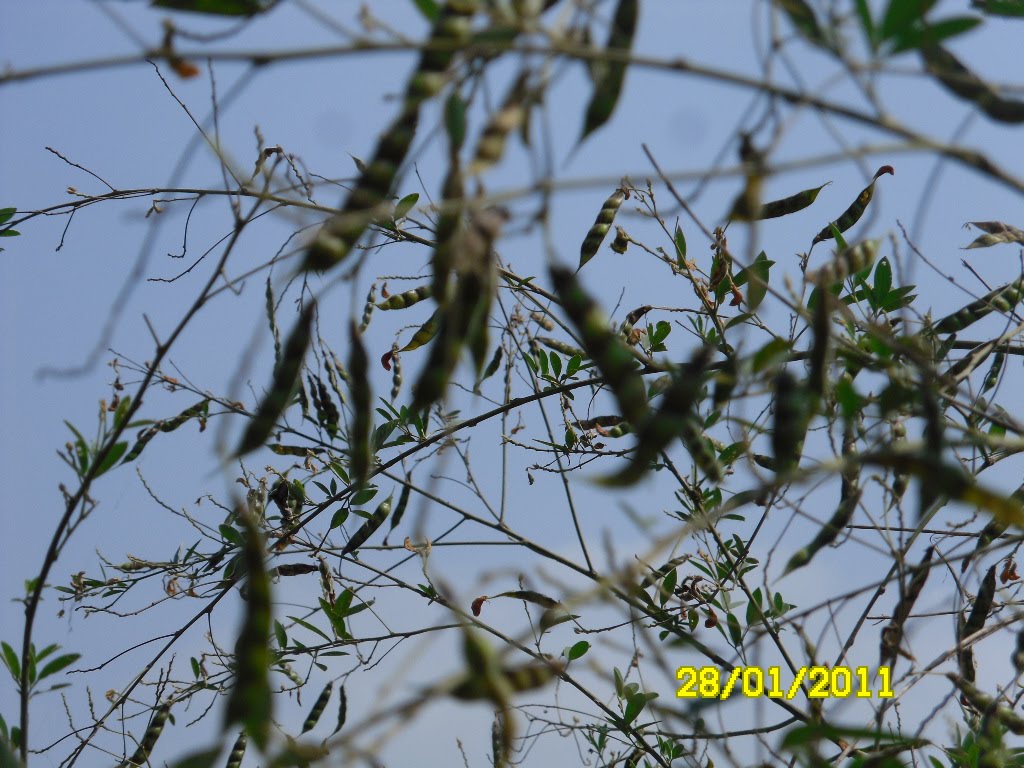
thuvarai - pigeon pea - toor dal is quite a magical tree.

these trees were planted in late 2009 (ideal time is jul-august) and in a year this is how they look.
all brimming with pea pods.


i hear that the processing is quite tedious and time consuming.
we have to do it anyways, so anyone who is certain about how to process them, do drop in details on sriramskd AT gmail.

Sunday, January 23, 2011

ragi - take 2

the first ragi crop was an over-documented story.
and gratefully the output was commensurate to the documentation.

but more importantly, it was the first step on the move towards fukuoka's 'no-till' farming.

coming back to ragi.
it remains our most commonly eaten millet.
in the summer, 3 out of 4 breakfasts are ragi koozhu.

so the math was simple, one crop a year did not seem adequate. we would need at least 30-40 kgs of ragi per year for our own consumption.

and this was the season for any crop and we wanted to take a shot at a 3 month variety.
since we got the seeds from the guys who grow, consume and seed-save it regularly, we assume that this is not a hybrid seed variety.
the locals call it 'kulla kevaru' - short ragi.

since we had already used around a third of this mulched field for our vegetable scale up, we have attempted the transplant method on the balance of this field and have tried a simple broadcast approach on a nearby field.

the major differences from the previous planting were:
1. closer spacing - approx 6" between the saplings.
2. no inter-crop - last time we used cow pea - karamani.
3. and of course - the seed variety is a 90 day crop

the method was very similar to the previous time.

the nursery...around 25 days.


and the transplanting (much easier this time as the soil was softer and the team was more experienced.


and the final field...


as we always say, keep watching this space.

rice experiment 2 - update

the first rice experiment in the pond did not come through.
the second experiment is running and was on a different spin. to grow it in a rain-fed manner and without any flooding.

we had planted a 3 monther (variety called gundu) and a 4 monther (variety called thuyamalli).

have to say that they look reasonable.

the field with gundu...


though they are running a bit behind schedule, we realise that even this level of maturing with the very poor level of fertility is amazing. check the close ups of the grain heads.


the field with thuyamalli...a mite less promising than gundu.


maybe in a month, you should read about the harvest and stuff.